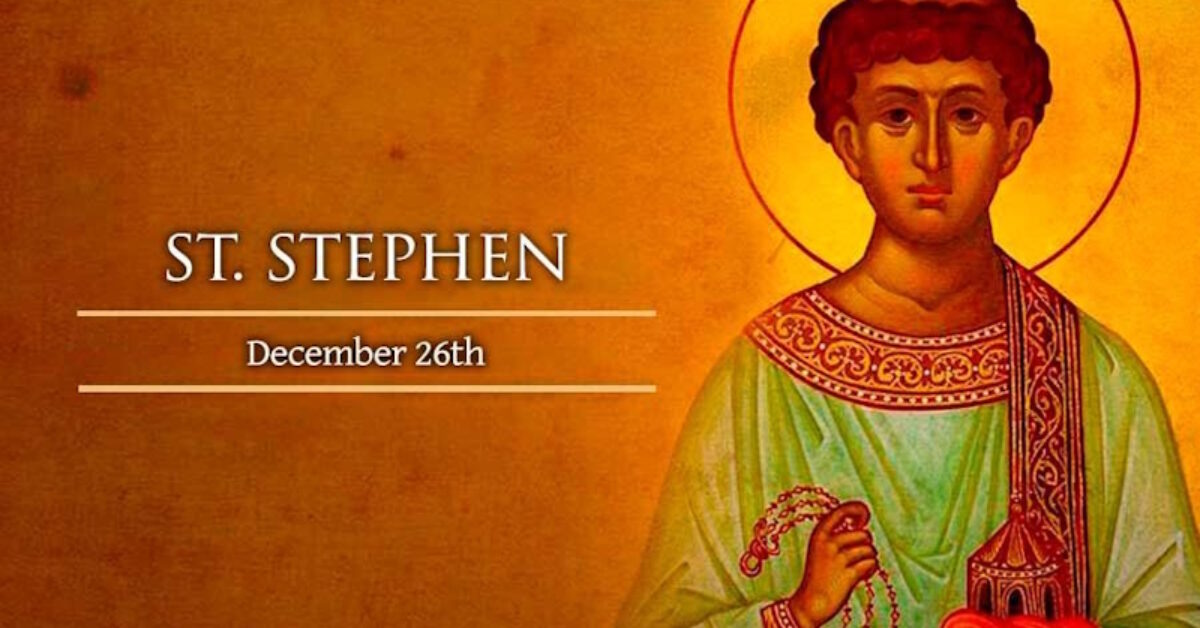
The Virtues of St. Stephen
As Alan Kreider and others have adequately demonstrated, the early church catechumenate facilitated the creation of new Christians by focusing on matters of believing, belonging, and behaving. And as Kreider showed in The Patient Ferment of the Early Church, one of the focal points of distinct Christian behavior was the virtue of patience. According to Martin Luther a wondrous example of these virtues is the saint commemorated today, the deacon and protomartyr of the fledgling church, St. Stephen. As Luther says:
Who can number the virtues illustrated in Stephen’s example? There loom up all the fruits of the Spirit. We find love, faith, patience, benevolence, peace, meekness, wisdom, truth, simplicity, strength, consolation, philanthropy. We see there also hatred and censure for all forms of evil. We note a disposition not to value worldly advantage nor to dread the terrors of death. Liberty, tranquility and all the noble virtues and graces are in evidence. There is no virtue but is illustrated in this example; no vice it does not rebuke. Well may the evangelist say Stephen was full of faith and power. Power here implies activity. Luke would say, “His faith was great; hence his many and mighty works.” For when faith truly exists, its fruits must follow. The greater the faith, the more abundant its fruits.
True faith is a strong, active and efficacious principle. Nothing is impossible to it. It rests not nor hesitates. Stephen, because of the superior activity of his faith, performed not merely ordinary works, but wrought wonders and signs publicly — great wonders and signs, as Luke says. This is written for a sign that the inactive individual lacks in faith, and has no right to boast of having it. Not undesignedly is the word “faith” placed before the word “power.” The intention was to show that works are evidence of faith, and that without faith nothing good can be accomplished (Lenker edition of Luther’s sermons, vol. 6, Epistle text, St. Stephen’s Day).
Behaving—works—are evidence of faith. And what faith and evidence of faith are manifest in the protomartyr? On this day after the nativity of the Word made flesh, Christ Jesus the Lord, the results of the Lord’s catechumenate of his children are in full evidence. Following the Lord, St. Stephen’s virtues are worthy of learning and emulating. For, as Luther says, in him “loom up all the fruits of the Spirit.” The birth of the Son of God has brought a new existence into his creation, for that let us give God thanks and praise. And let all the fruits of this new life bloom in abundance in our lives.