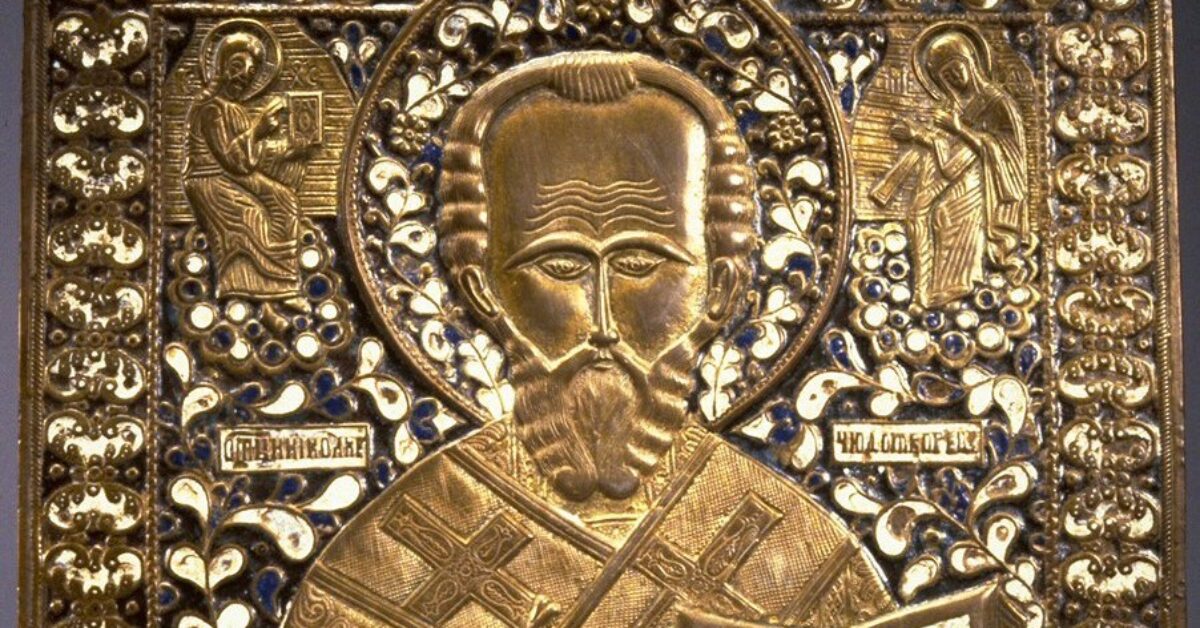
Feast of St. Nicholas
Shrouded in legend, Bishop Nicholas of Myra (270-343) evolved over the centuries into the patron saint of children (in the West) and sailors (in the East). According to one Roman Catholic source, this devolution—my word, not that of my source—of a fourth-century saint revered for acts of mercy and charity into the King of consumerism at Christmas started in Protestant circles.
“…the giving of presents at Christmas … is not an old Catholic custom. It seems to have originated among the Protestants of the Low Countries and to have been taken to America by the Dutch immigrants of New Amsterdam” (Butler, Lives of the Saints, December vol., 60). The name “‘Santa Claus’” derives from “the Dutch ‘Sint Niklaas’” (ibid., 59).
Having long been horrified by the bad theology promoted in the secular song “Santa Claus is Coming to Town,” along with the threats I’ve heard parents say to their children (“If you don’t stop … if you’ve not nice to your sibling, Santa won’t …”), I long for a rehabilitation of St. Nicholas in Protestant circles. For readers who do not yet have an ear worm of the song in their heads, click here for the heretical lyrics.
Let us turn away from self-centered works righteousness, from seeking “rewards” of material gifts based on our distorted desires, from falling into do-ut-des transactional living promoted in this song. If, as Lutherans confess, “the saints are to be remembered so that we may strengthen our faith when we see how they experienced grace …. Moreover, it is taught that each person, according to his or her calling, should take the saints’ good works as an example” (Augsburg Confession XXI, Kolb/Wengert edition, p. 58), there are portions to embrace from St. Nicholas’ hagiography.
One legend tells of a poor father unable to provide doweries for his three daughters. With no way to provide for their future, the father considered a life of prostitution for them. Nicholas, hearing of the family, threw three bags of gold into an open window of the home. The legend is consistent with the Christian virtues attributed to him, a man of deep piety and generosity with a strong sense of justice for people on the margins. This saying, attributed to St. Nicholas, encapsulates not only sound biblical theology but also lifts up a spirit of generosity, an action for Christians to imitate in this season that reflects the legend of this saintly bishop:
The giver of every good and perfect gift has called upon us
to mimic God’s giving, by grace, through faith, and this is not of ourselves.
+++
Next week’s blog will be another segment of Armand Boehme’s series on catechetical preaching.
+++
Icon of St. Nicholas, anonymous Russian artist, ca. 1800; Walters Art Museum, Public domain, via Wikimedia Commons
https://commons.wikimedia.org/wiki/File:Russian_-_Icon_of_Saint_Nicholas_-_Walters_44648.jpg
