Life in Christ – Old Testament
What does it look like to use the catechetical narratives of Luther’s Small Catechism and Augustine’s Catechumenate in tandem, or as I call it, Life in Christ? Over the next two blog posts, I want to give a concrete, albeit cursory, overview.[1]
Life in Christ is predicated on two vital premises that enable you to merge Luther’s Small Catechism and Augustine’s Catechumenate seamlessly. First, the Bible is a unified historical narrative that centers on the person and work of Jesus (John 5:39; Luke 24:26-27). And second, the historical narrative, Genesis to Revelation, has an ultimate goal: divine presence or eternal life with our eternal God.[2] Life in Christ begins with the first of the Easter Vigil narratives, Genesis 1-3. In this section, we see how “God created the heavens and the earth.”[3] All things were created good/perfect. And man and woman were created to be in an intimate face-to-face relationship with God (Gen 3:8), where there is no sin, illness, disease, mourning, crying, pain, or death (Gen 3:8; Gen 2:17; Rev 21:4). But the fall into sin corrupted humanity’s heart/nature and resulted in temporal and eternal death, separation from the holy and perfect God (Gen 3:23-24). “How bad is humanity’s corruption that caused separation from and loss of God’s presence,” I ask? We look not only at the man’s and the woman’s response, but also at the Ten Commandments.[4] This shows that “all have sinned and fall short of the glory of God” (Rom 3:23), and that “the wages of sin is death” (Rom 6:23). At the conclusion of the first chief part, I ask,
“So there is no hope? We can never be in God’s presence again? Is there nothing left for us but illness, disease, mourning, crying, pain, sin, and death?” The answer, of course, is that there is hope. And it comes from God, not us.
Genesis 3:15, the driving question of the rest of the Old Testament biblical narrative of divine presence, is then summarized as follows: “Where is this promised child (promised seed) who is going to crush the head of the serpent and restore to us the presence of God (promised land)?”
The remaining Easter Vigil narratives (Gen 7-9; Gen 22:1-18; Ex 14:10-15:1; Isa 55:1-11; Ezek 36:24-28; Ezek 37:1-28; Deut 31:19-30; Job 19:20-27; John 3:1-10; Zeph 3:12-20; Dan 3:1-30) are taught in light of this question, since each narrative focuses on either a genealogical descendant or the promised land. The vigil narratives conclude, with the people of God, like Adam and Eve before them, waiting, watching, and wondering for the next four hundred years, “Where is the promised child who will crush the head of the serpent and restore to us the presence of God?”
The answer brings us to Jesus, and the remaining five chief parts of Luther’s Small Catechism.
[1] For a complete summary of the content of “Life in Christ” see Adam Filipek, Life in Christ: Rooted, Woven, and Grafted into God’s Story, (St. Louis, MO: Concordia Publishing House, 2023).
[2] See Jn 20:31; Luther also expresses the goal of divine presence in his meaning to the second article of the Apostles’ Creed when, after speaking about the work of Jesus he says that “… His innocent suffering and bitter death” occurred, “that I may be his own and live under Him in his kingdom …”
[3] Gen 1:1; Gen. 2:17; also Article 1 of the Apostles’ Creed and its explanation in Luther’s Small Catechism.
[4] Gen. 3:8-24; The Ten Commandments are taught using both the Small and Large Catechisms.
+++++++
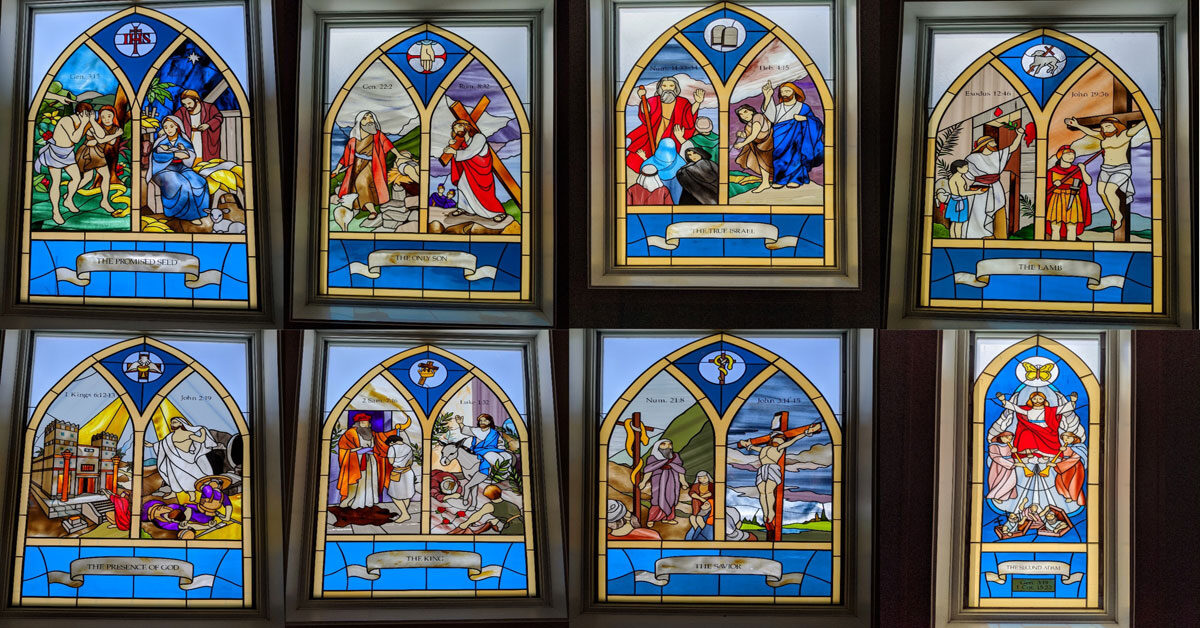
Banner photo: The stained-glass windows at Immanuel Lutheran Church, Lidgerwood, ND depict the story of God’s salvation for us in Jesus Christ that spans from Genesis through Revelation. Titled “Shadows to Realities” and created by Rev. Dr. Adam Filipek, the windows were designed by Darla Rufer from Stained Glass Overlay of Red River Valley. For more details, click here.