Life in Christ – New Testament
After four hundred years of deafening silence, God speaks. “Where is the promised child who will crush the head of the serpent and restore to us the presence of God?” The answer is found by taking the catechumens to Luke’s genealogy (Lk 3:23-38, with specific emphasis given to verses 36-38), since it matches the genealogy of Genesis 5:1-28. Specific passages from the Gospels of Matthew, Luke, and John are all used to show that God fulfilled the promise he made in Genesis 3:15 and throughout the Old Testament (Matt 1:18-25; Lk 1:5-56 and 2:1-20; Jn 1:1-14 and 2:19-22). In the fullness of time God sent forth his only-begotten Son, Jesus, to crush the serpent and restore to us the presence of God (Gal 4:4). The flesh of Jesus is the new tabernacle/temple, which is greater than the former, because now the presence of God is not confined to a building, veiled behind a curtain, nor beheld by a priest only once a year; rather, it is out in the open, veiled in flesh, and is to be beheld by all people. Or, returning simply to the text, Jesus is “the son of Adam, the son of God” (Lk 3:38).
“But just what does it mean that Jesus is the son of Adam and Son of God? And how exactly does he crush the head of the serpent so that we can have the presence of God restored to us?” I ask. Specific attention is given to the Second Article of the Apostles’ Creed and its meaning from Martin Luther’s Small and Large Catechisms, the narratives of Jesus’ childhood, baptism, temptation,[1] five specific miracles of Jesus (Creation: Mk 4:35-41; Devil: Mk 1:21-28; Illness: Mk 1:40-45; Sin: Mk 2:1-12; Death: Jn 11),[2] the triumphal entry, betrayal, trial, crucifixion,[3] resurrection, and ascension narratives, and Revelation 21:3-5,[4] to show that Jesus, the great high priest, offered himself as the perfect pascal Lamb of sacrifice so that we could be set free from our slavery to sin, passover from death to life, and ultimately “live under him in his kingdom, and serve him in eternal righteousness, innocence, and blessedness.”[5] In summary I reiterate that, “God has joined you in the flesh (his human body), so that you may join Him in your flesh for eternity.”
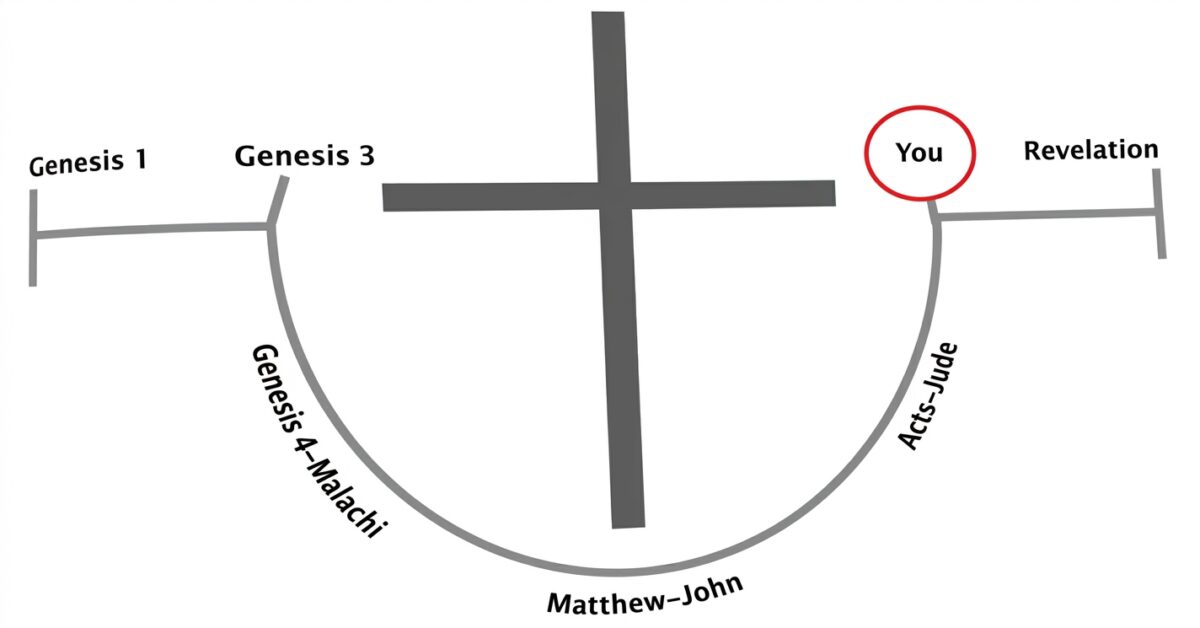
“There’s just one problem,” I then say. “We’re not at the end of God’s story yet. And we are not in the beginning either. We are in the middle. We are waiting for Jesus, who as crushed the head of the serpent, to return and take us to be with him forever. And as we wait, I have to ask: where is God present today, in 2026?” To answer that question, the Third Article of the Apostles’ Creed is taught in conjunction with The Sacrament of Holy Baptism, Confession, The Sacrament of the Altar, the Lord’s Prayer, and Table of Duties in the Small Catechism to show that Jesus is present where he has promised to be, namely in Word and Sacrament, as given in the Divine service, and in the baptized as they love and serve their neighbor. These are the very places that God has promised to be with us, “until the end of the age.” [6] Thus, whether we are living in time or in eternity, our lives are and always will be lived in Christ.
[1] The focus of the four childhood narratives (Lk 2:21; Lk 2:22-40; Lk 2:41-52; Matt 2) is Jesus’s perfect obedience to and fulfillment of the Law. Jesus’s baptism was taught as an anointing and inauguration of Jesus’s ministry, and thus the beginning of his vicarious substitution which was ultimately accomplished by his death and resurrection. Jesus’s temptation was typologically connected to Israel’s temptation during their wandering in the wilderness. Where Adam and Israel had failed, Jesus succeeded by remain faithful to the Father’s Word. Hence Jesus was purported as “Israel reduced to one.”
[2] While there are certainly many other miraculous narratives, these five were selected because they specifically parallel the previously identified and taught consequences that resulted from the fall into sin back in Gen 3. Additionally, the question that frames the miracle discussion is: “What happens when Jesus comes near to (is present with) a creation that has gone awry, the devil, illness, sin, and death?” The answer is they are undone. Finally, these five miracles typify what Jesus will accomplish on a larger scale for us outside of Jerusalem on the cross and in the empty tomb.
[3] Typological connections that were taught in this section can be articulated as follows: Jesus, God’s only Son (Gen 2:2, 13-14, Jn 3:14-16), our high priest (Ex 30:9-10, Lev 16, Heb 8-10), offered himself as the perfect lamb of sacrifice (Ex 12:4-7, Jn 19:34-36), forever tearing the curtain in two (2 Ch 3:14, 54, Matt 27:51), completing the work of our salvation/reconciliation (Gen 2:2, Jn 19:28-30), and granting us access to God’s unveiled presence once again (Gen 1-2, Rev 21:3-5).
[4] In order to give the catechumens a complete and easy to read account of these narratives, I distribute a copy of “The Passion of Our Lord Jesus Christ Drawn from the Four Gospels” as printed in Commission on Worship, Altar Book, 487-93. It should also be noted that these are the appointed readings for Passion/Palm Sunday and were heard by the catechumens then, in their liturgical context.
[5] SC, Apostles’ Creed, Article 2, in BC, Kolb and Wengert, 355.
[6] See Matt 18:20, Matt 28:19-20, and Luther’s Works, Vol. 14, Selected Psalms III, 114.