The author of Hebrews, alluding to the account in Genesis 18 of the three men/angels/the Lord visiting Abraham and Sarah, wrote,
“Let mutual love continue. Do not neglect to show hospitality to strangers, for by doing that some have entertained angels without knowing it” (Heb 13:1-2).
Shortly after returning home from the Best Practices Ministry 2026, all the attendees (I assume) received an email from Jeff Schrank, pastor of Christ Lutheran in Phoenix, which hosts the conference. Jeff wrote:
“Would you please be willing to reflect upon how this event impacts you, your team, your church? I will share these thoughts with the congregation and the army of volunteers that wanted to encourage you last week.”
Here, Jeff, is my response to your email. This year was my third time attending BPM, and what amazed me that first year continues to blow me away, namely the astonishing love and hospitality of the people of Christ Church, especially those who serve behind the scenes. This year was the first time I was able to thank in person the women who clean and replenish the restrooms during sessions. In all my restroom breaks at BPM I have never encountered an empty paper towel or soap dispenser, trash on the floor, an unflushed, dirty toilet, or (most amazingly) a stall lacking toilet paper. To walk into fully stocked, clean restrooms at all times and in all places (on the church/school campus) is no small thing; it is emblematic of the beautiful hospitality that is a hallmark of BPM. And hospitality, while it may not be among the fruits of the Spirit, is a concrete way of expressing the love of Christ for all.
This year was also the first time I had occasion to speak with one of the hundreds of volunteers (pictured here) who make attending BPM an extraordinary experience of love and hospitality. Since I have forgotten her name, I’ll call her Grace. She was cleaning the tables outside the entrance to the building where the meals were served and took time to share with me that the people of Christ Lutheran consider it an honor and joy to serve in any way, even the lowliest of tasks. Grace used to be on restroom duty and was a bit miffed to have been transferred to the more public task of table wiping! That she and others did this service without seeking honor or praise for their work was clear; they were motivated by the love of Christ for them and their desire to provide a few days of encouragement, community, and respite for professional and lay workers in God’s Kingdom.
The author of Hebrews is not the only New Testament writer who exhorts Christians to practice hospitality and to pair this virtue with love; no less that Peter and Paul did so as well.
The end of all things is near; therefore be serious and discipline yourselves for the sake of your prayers. Above all, maintain constant love for one another, for love covers a multitude of sins. Be hospitable to one another without complaining. Like good stewards of the manifold grace of God, serve one another with whatever gift each of you has received (1 Peter 4:7-11).
Let love be genuine; hate what is evil, hold fast to what is good; love one another with mutual affection; outdo one another in showing honor. 11 Do not lag in zeal, be ardent in spirit, serve the Lord. Rejoice in hope, be patient in suffering, persevere in prayer. Contribute to the needs of the saints; extend hospitality to strangers (Romans 12:9-13).
Thanks be to God for the love and hospitality of all at Christ Church Lutheran!
Although it is (apparently) an urban legend that the origin of the carol “The Twelve Days of Christmas” stems from a time when Roman Catholics in England (16th to early 19th centuries) were not allowed to practice their faith openly, we’re featuring the modern legend on today’s post. The carol was purportedly written as a catechumenal song to teach youth Catholics about their faith, with each gift holding the hidden meaning of a Christian truth. As critics have pointed out, the 12 “hidden meanings” are shared by Christians across denominational boundaries; there is nothing distinctive to Roman Catholicism in them, and the hypothesis is rather recent. Nevertheless, I find the “hidden meanings” a lovely way to christianize an otherwise secular “carol,” especially since the celebration of Christmas by those for whom it is a secular and cultural holiday ends on “the second day of Christmas.”
Here are the 12 hidden meanings:
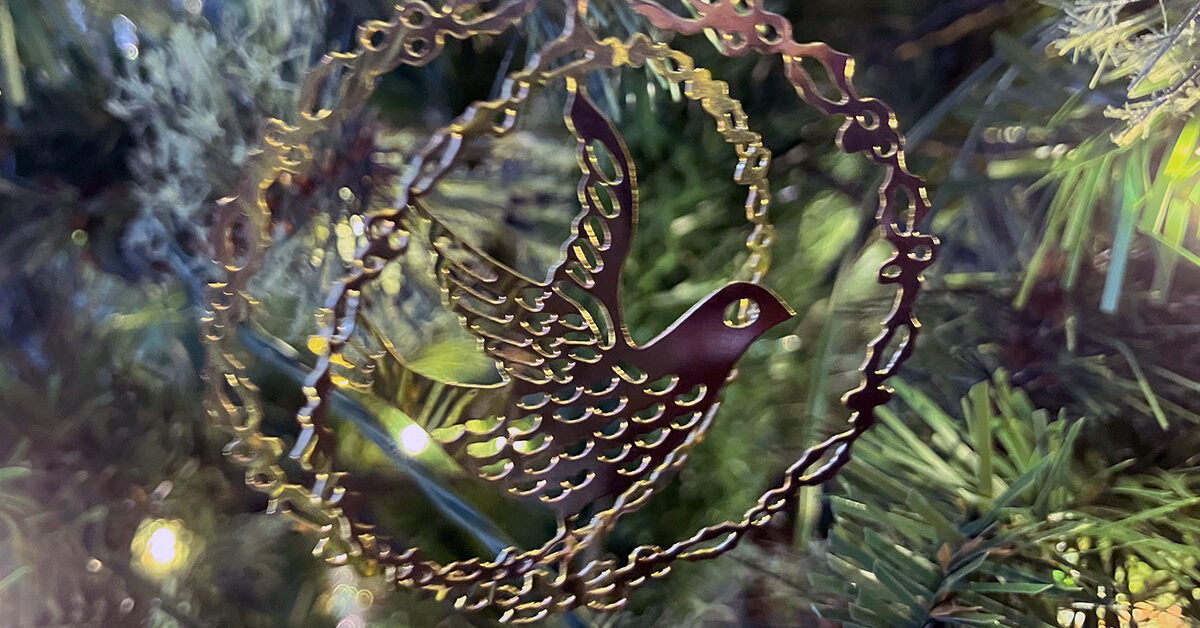
The Partridge in the pear tree is Jesus Christ.
Two turtle doves are the Old and New Testaments.
Three French hens stand for faith, hope, and love.
The four calling birds are the four gospels of Matthew, Mark, Luke, and John.
The five golden rings recall the Torah or law, the first five books of the Old Testament.
The six geese a-laying stand for the six days of creation.
Seven swans a-swimming represent the sevenfold gifts of the Holy Spirit: prophesy, serving, teaching, exhortation, contribution, leadership, and mercy.
The eight maids a-milking are the eight beatitudes.
The nine ladies dancing are the nine fruits of the Holy Spirit: love, joy, peace, patience, kindness, goodness, faithfulness, gentleness, and self-control.
The ten lords a-leaping are the ten commandments.
Eleven pipers piping stand for the eleven faithful disciples.
Twelve drummers drumming symbolize the twelve points of belief in the Apostles’ Creed.
This list could be a great way to teach some basics of the faith to both children and adults in a fun and festive atmosphere, perhaps as a Bible class or Sunday School lesson in early January (during the 12 days).
++++
Banner image: Photo by Rhoda Schuler, 2026
Sources consulted about the “hidden meaning” of the carol:
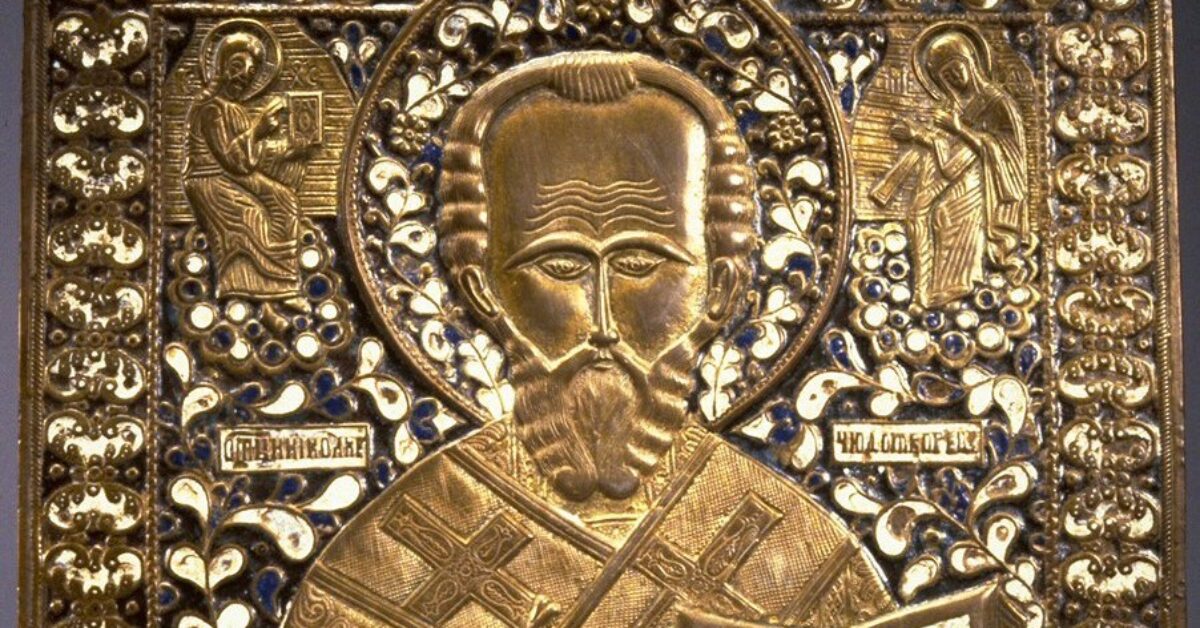
Shrouded in legend, Bishop Nicholas of Myra (270-343) evolved over the centuries into the patron saint of children (in the West) and sailors (in the East). According to one Roman Catholic source, this devolution—my word, not that of my source—of a fourth-century saint revered for acts of mercy and charity into the King of consumerism at Christmas started in Protestant circles.
“…the giving of presents at Christmas … is not an old Catholic custom. It seems to have originated among the Protestants of the Low Countries and to have been taken to America by the Dutch immigrants of New Amsterdam” (Butler, Lives of the Saints, December vol., 60). The name “‘Santa Claus’” derives from “the Dutch ‘Sint Niklaas’” (ibid., 59).
Having long been horrified by the bad theology promoted in the secular song “Santa Claus is Coming to Town,” along with the threats I’ve heard parents say to their children (“If you don’t stop … if you’ve not nice to your sibling, Santa won’t …”), I long for a rehabilitation of St. Nicholas in Protestant circles. For readers who do not yet have an ear worm of the song in their heads, click here for the heretical lyrics.
Let us turn away from self-centered works righteousness, from seeking “rewards” of material gifts based on our distorted desires, from falling into do-ut-des transactional living promoted in this song. If, as Lutherans confess, “the saints are to be remembered so that we may strengthen our faith when we see how they experienced grace …. Moreover, it is taught that each person, according to his or her calling, should take the saints’ good works as an example” (Augsburg Confession XXI, Kolb/Wengert edition, p. 58), there are portions to embrace from St. Nicholas’ hagiography.
One legend tells of a poor father unable to provide doweries for his three daughters. With no way to provide for their future, the father considered a life of prostitution for them. Nicholas, hearing of the family, threw three bags of gold into an open window of the home. The legend is consistent with the Christian virtues attributed to him, a man of deep piety and generosity with a strong sense of justice for people on the margins. This saying, attributed to St. Nicholas, encapsulates not only sound biblical theology but also lifts up a spirit of generosity, an action for Christians to imitate in this season that reflects the legend of this saintly bishop:
The giver of every good and perfect gift has called upon us to mimic God’s giving, by grace, through faith, and this is not of ourselves.
+++ Next week’s blog will be another segment of Armand Boehme’s series on catechetical preaching.
I’m nostalgic for 2017, a year filled with special commemorations of the 500th anniversary of Luther’s 95 Thesis and the reforms of the church launched by that event. While most people today (October 31) are fixated on costumes for their kids, Halloween candy to give out, or creepy lawn decorations, I’m musing about Luther’s 1520 treatise The Freedom of a Christian (Quotations are from The Annotated Luther Study Edition, edited by Timothy J. Wengert, Fortress, 2016). Luther wrote: “In order to point out an easier way for common folk (for I serve only them), I am proposing two themes concerning the freedom and servitude of the spirit.”
The Christian individual is a completely free lord of all, subject to none.
The Christian individual is a completely dutiful servant of all, subject to all (488).
The remainder of Luther’s treatise shows how these paradoxical statements are both true. As a child and youth growing up in the Lutheran church, I heard a much greater emphasis on the first theme: the Christian is “completely free” and “subject to none” on account of one’s faith in Christ (not on one’s good works), and most of the preaching (that I recall, at least), centered on my future life with God in heaven, guaranteed by that faith in Christ. But having lived my entire adult life as a deaconess, with its emphasis on service, I revel in the interconnection of Luther’s two themes. Joyful service on behalf of others flows from the firm foundation of a person’s complete freedom through faith in Christ. Luther says it with greater eloquence in the second half of the treatise.
Up to now we have spoken about works in general and, at the same time, about those specific things that a Christian must do to train his or her own body. Finally, we will discuss those things done for one’s neighbor…. Thus, it can never happen that in this life a person is idle and without works toward one’s neighbors…. Nevertheless, no one needs even one of these works to attain righteousness and salvation. For this reason, in all of one’s works a person should in this context be shaped by and contemplate this thought alone: to serve and benefit others in everything that may be done, having nothing else in view except the need and advantage of the neighbor…. That is, with joy and love [faith] reveals itself in works of freest servitude, as one person, abundantly filled with the completeness and richness of his or her own faith, serves another freely and willingly (519-21).
Thanks be to God for the richness of Luther’s theology, that draws us into relationship with God through the person and work of Jesus and Christ, and then frees us for a life a service on behalf of others. Our world needs this message now, just as it did 500 years ago.
++++
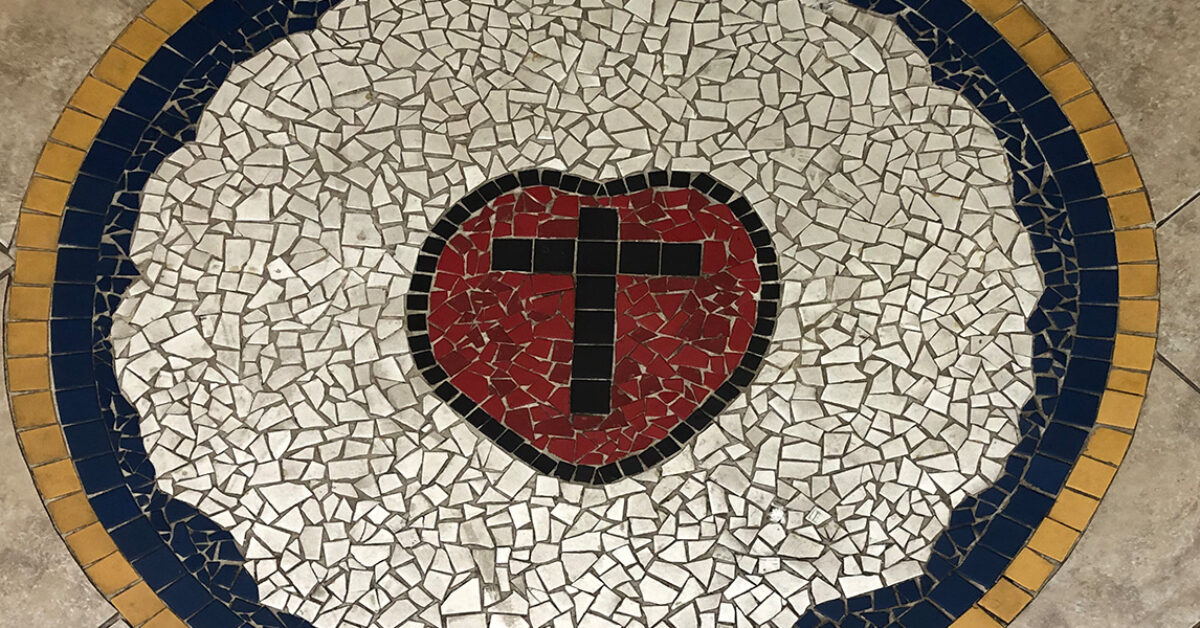
Photo by Rhoda Schuler, 2024: Narthex floor of a Lutheran church in Colorado
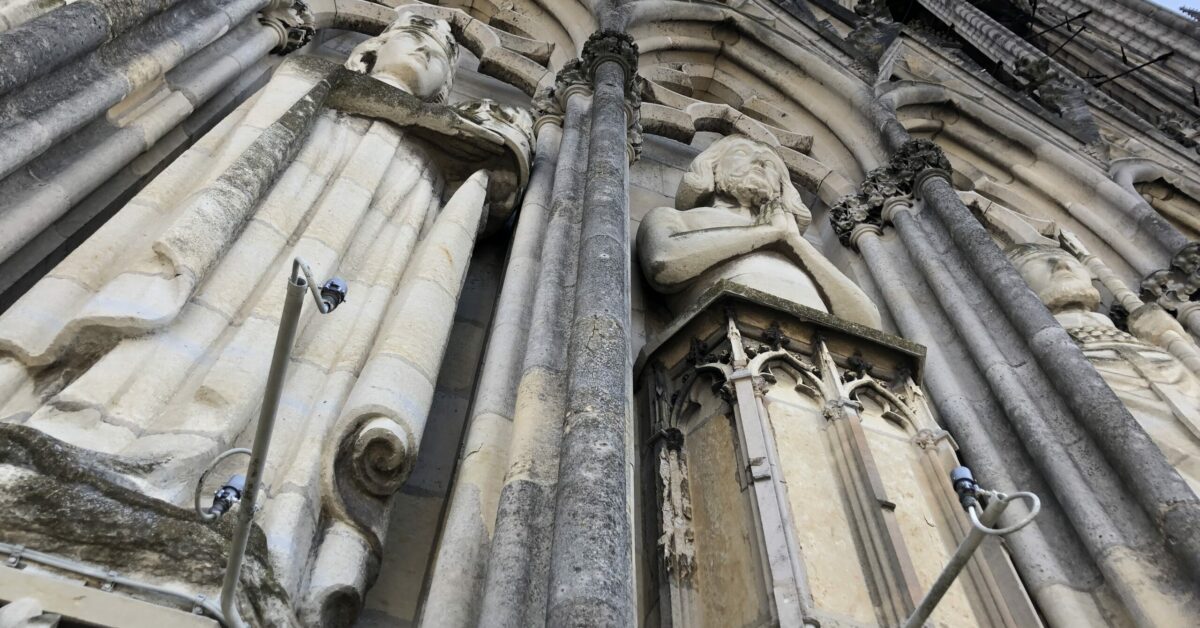
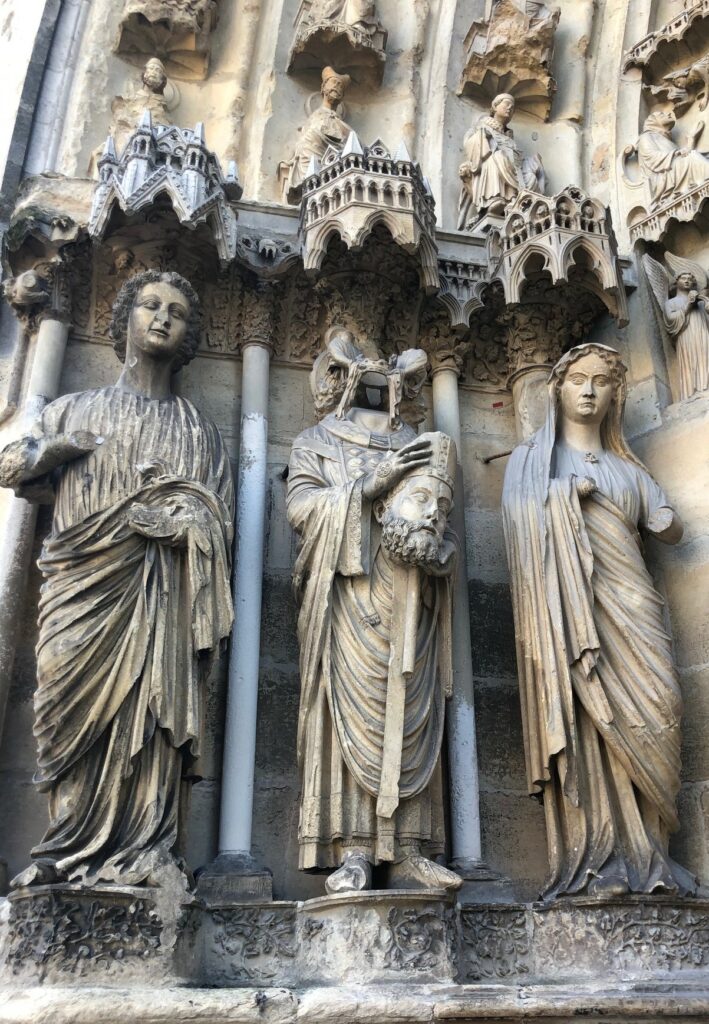
Notre Dame de Reims Cathedral has a rich history of martyrs, bishops, and royals. As part of the Roman Empire, there is evidence of a Christian presence in Riems in the middle of the third century. The first church on the present site of the cathedral was built around 400 by St. Nicasius (Nicaise), a bishop who died by the hands of invaders (likely Huns, according to one source) when they plundered the city.[1] The statue of him on the north entrance of the church depicts him holding his head with its bishop mitre, indicating a tradition of beheading for his death (photo, right).
But more famous than Bishop Nicaise (French spelling) is Bishop Rémi or Remigius (c. 443 – 533), who is partially visible on the far right in today’s banner photo. In the center is Clovis (c. 466 – 511), King of the Franks, standing in the baptismal font. To the left of Clovis, holding his crown, is St. Coltilde (474 – 545), a Burgundian princess married to Clovis; she was a devout Catholic at a time when Arians were the majority. Clovis was not Christian, but when he appealed to his wife’s God in battle and won, he consented to be baptized (between 496 and 508), and “became the only Catholic sovereign in Christendom.”[2] Gregory of Tours wrote of the event (quoted in Butler’s Lives of the Saints):
Among clouds of incense … “like a new Constantine he moved forward to the water, to blot out the former leprosy, to wash away in this new stream the foul stains from old days.”
But it is Queen Clotilde (not Clovis) whose life can inspire us 1500 years later. Like many couples today, she was the devout partner whose faith was an instrument of the Spirit, drawing her beloved toward Christ and his redemptive work. In our research on the adult catechumenate, Kent and I have encountered similar stories (without the baggage of royalty), such as that of Gail and George. George was the devout one, and Gail, with little connection to and knowledge of Christianity, recognized early in their relationship that attending church was important to George, and so she started coming with him. When I interviewed them, they had been married about two years and were attending the adult catechumenal sessions together; Gail related that she had many questions and doubts. But when she had consented to the baptism of her own child and understood that meant raising the child as a Christian, she realized that she, too, had to be claimed by Christ in this initiation ritual, and so she, like Clovis, moved into “this new stream” of cleansing water.
[1]Butler’s Lives of the Saints, St. Nicasius, 14 December.
[2]Butler’s Lives of the Saints, St. Clodilda, 3 June.
+++++++
Photos of Riems cathedral by Rhoda Schuler, June 2024
Kent has passed the blogger’s baton to me (Rhoda) for the month of July. Having just returned from travels in Europe (where Christianity is waning) and Ethiopia (where Christianity is flourishing), I’ll be sharing some of my pilgrimage experiences, reflecting on baptism, Christian formation, and the presence of Christ in and through the church now and in the past.
The photo (left) is of the UNESCO site, the Abbey of Mont Saint Michel, an island gem off the coast in Normandy, France. The legend surrounding this magnificent site is recorded in a ninth-century document, Revelatio Ecclesiae Sancti Michaelis, which relates events purportedly from 708, when the archangel St. Michael (for biblical references, see Daniel, chapters 10 and 12; Jude 9; Revelation 12:2-12) appeared to Bishop Aubert of Avranches in a dream and instructed him to build a church honoring St. Michael. The chapel eventually built by the bishop (who was as slow as Peter in Acts 10 to catch on to a vision from heaven) was a replica of a cave shrine in Italy built on a spot where St. Michael was said to have appeared in 492. Thus, this remote and holy place was dedicated to St. Michael and quickly became a major pilgrimage site. In 966, a Benedictine presence replaced the group of priests (“canons”) who had managed the pilgrimage site for several centuries. Today the tourists and pilgrims tour the monastic complex built by the Benedictines from the eleventh to the fifteenth centuries on this island rock. But I digress …
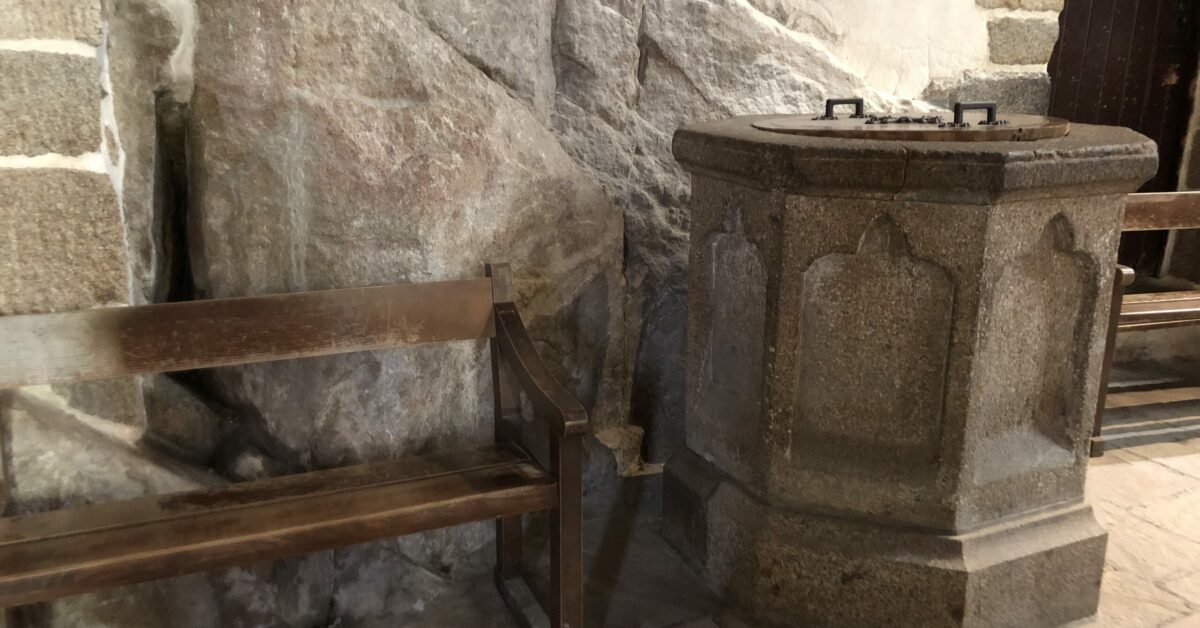
With the medieval pilgrims came economic opportunity. As the booklet published by Centre des Monuments Nationaux (purchased in the Abbey gift shop) says, the “flow of pilgrims thronging to the abbey prompted merchants to settle on the rock…. The mercantile atmosphere in the village should not put off the modern visitor: it has always been a part of place” (17). To serve the spiritual needs of the merchants and their families, a parish church was formed; the present building dates from the fifteenth century and is still functioning today. In this modest and ancient church is the baptismal font that heads this blog post. The estimated percentage of the French population that professes to be Christian today is about 50%, making it remarkable that the parish church in this tiny village is still a living and active Christian community. When we visited, there was no sign of when the font had been last used, but there were flyers announcing parish activities, fresh flowers adorning the main and side altars, and prayer requests written in a book. The monastic presence ended with the French Revolution, and from 1793 to 1863 the abbey complex was used as a prison. But the presence of devout Christians who gather regularly for worship has continued (perhaps uninterrupted) through seismic historic events—the Revolution and resulting separation of church and state, the World Wars of the twentieth century, the process of “secularization” and rising number of those with no religious affiliation of the last half century. The architectural masterpiece of the abbey complex is indeed breath-taking and glorious, but the constancy of the living, active Body of Christ in this modest, medieval church is more profound and inspiring.
Several decades ago, one Wednesday evening after a particularly difficult session with a singularly unruly class, the devout lay woman and long-time teacher for fifth- and sixth-grade confirmation instruction at our church had had enough; she quit. Feeling called (reluctantly, like Jonah) to step into the role and finish the school year, I took up my cross and entered the classroom the following Wednesday.
My only clear memory of those weeks as their confirmation teacher was this question posed by Douglas, a pistol of a kid who was rarely engaged in the material and was prone to disruptive behavior: “If it’s the day Jesus died, why do we call it good?” Not one to think quickly in such a situation, all I could say was, “That’s an excellent question, Douglas.” A profound one, indeed. If I were to meet Douglas today, I might answer him with several stanzas from the Holy Week hymn by Venantius Honorius Fortunatus (c. 530-609).
Sing, my tongue, the glorious battle; sing the ending of the fray.
Now above the cross, the trophy, sound the loud triumphant lay;
Tell how Christ, the world’s Redeemer, as a victim won the day.
+++
God, in mercy saw us fallen, sunk in shame and misery,
felled to death in Eden’s garden, where in pride we claimed the tree;
then another tree was chosen, which the world from death would free.
+++
Faithful cross, true sign of triumph, be for all the noblest tree;
None in foliage, none in blossom, none in fruit your equal be;
Symbol of the world’s redemption, for your burden makes us free.
+++
Lutheran Service Book #454, stanza 1; Evangelical Book of Worship #355, stanza 2; Lutheran Book of Worship #118, stanza 4
If I were back in that fifth- and sixth-grade classroom this week, I might point out to Douglas and the whole class the paradoxical nature of the cross, first leading them to an understanding of the cross as symbol of shame and brutal form of capital punishment wielded by the Roman Empire, and then to deeper knowledge of the cross as a “true sign of triumph,” and as a “symbol of the world’s redemption.” I would pray that as Spring brings forth foliage, blossom, and fruit on the many trees lining their streets and in their yards, parks, and orchards, they would compare those to the noblest of trees, the cross, noblest because of the “burden” it bore—the scourged body of Jesus, whose death “makes us free.”
+++++++
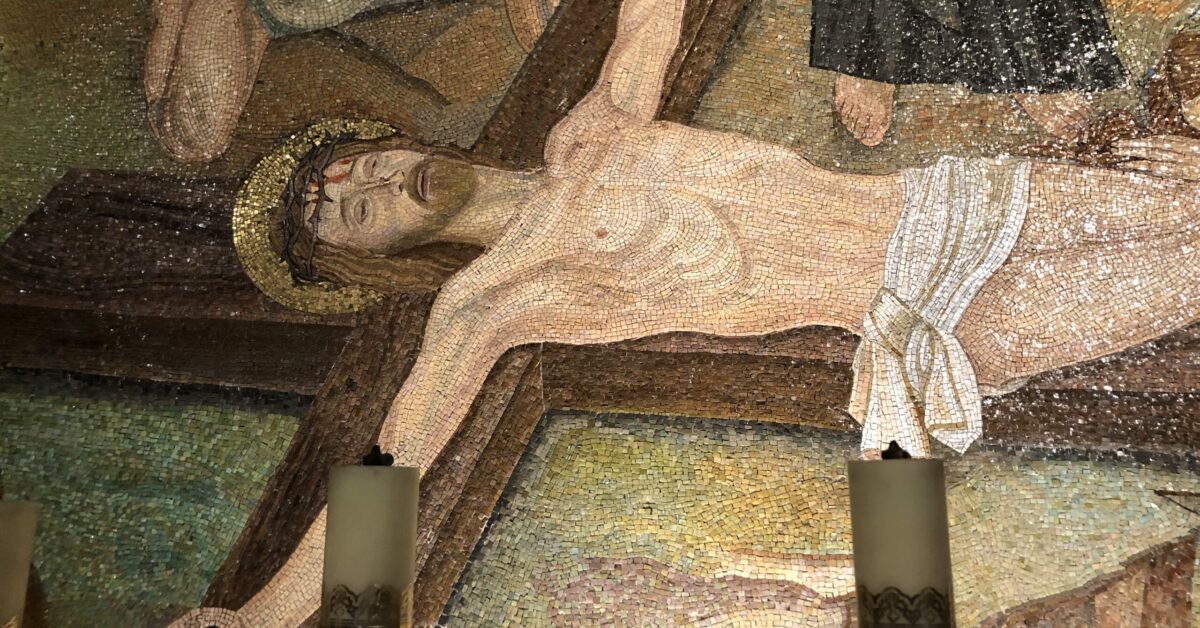
Photo by Rhoda Schuler; Church of the Holy Sepulchre, Old City of Jerusalem; mosaic behind altar in the Latin Chapel of the Crucifixion; Jesus being nailed to the cross; March 5, 2023.
This excerpt from Leo the Great’s Christmas sermon (preached in 450) draws together biblical themes of baptism with the mystery of the Incarnation:
Christ’s birth, says Leo, is “the origin of” all Christians, the body of Christ
Just as we have been joined with Christ’s death and resurrection in baptism, so we are “born along with him in his Nativity”
Jesus is born to Mary, “the child of a human being” in order that we might “become children of God”
May these ancient words by Leo the Great draw our readers to contemplate the Incarnation and its meaning in daily life in new ways.
When the faithful meditate about divine things, dearly beloved, the Birth of our Lord and Savior from his Mother comes to mind every day and all the time….
But no day suggests to us more than today that this Nativity should be worshipped in heaven and on earth…. We recall not only to mind, but even—in a way—to sight, the conversation of Gabriel with the astonished Mary, the Conception by the Holy Spirit (as marvelous in being promised as it was in being actually granted), the Maker of the world brought forth from a virginal womb, and the one who established all natures made the Son of her whom he had created.
On this day, the Word of God appeared clothed in flesh, and, what could not even have been seen by human eyes before, “could” now “be touched with the hands.” …
… Today’s feast, nevertheless, renews for us the sacred beginnings of Jesus’ Birth from the Virgin Mary. As we worship the Birth of our Savior, we find ourselves celebrating our own origin as well. For the Conception of Christ is the origin of the Christian people, and the birthday of the Head is the birthday of the body.
All of the elect have their own special place, and the Church’s children are set off from one another by the passage of time. Yet all of us, the whole sum of believers who have sprung from the baptismal font, just as we have been crucified with Christ in his Passion, been raised with him in his Resurrection, and been set at the right hand of the Father in his Ascension, so too have we been born along with him in his Nativity.
Whenever believers in any part of the world undergo regeneration in Christ, they become transformed into “new human beings,” through a rebirth … It was precisely so that we might be able to become children of God that he was made the child of a human being. Had he not come down to us in this humility, none could come to him by any merits of their own.
Leo the Great: Sermons (translated by Jane Patricia Freeland, C.S.B.J., and Agnes Josephine Conway, S.S.J.)
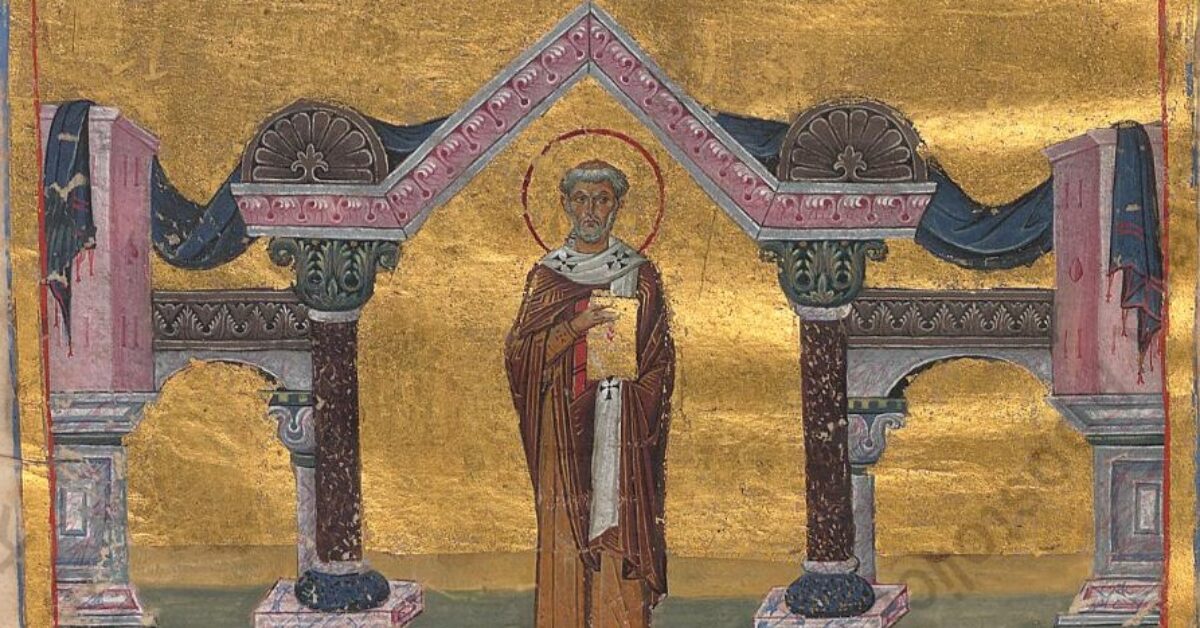
Title: Лев I Великий, папа Римский. Константинополь. 985 г. Миниатюра Минология Василия II. Ватиканская библиотека. Рим
Google translation of the Russian: Leo I the Great, Pope of Rome. Constantinople. [date:] 985. Miniature … of Basil II [Byzantine Emperor, r. 976-1025]. Vatican Library. Rome
For one who grew up on a farm in the Midwest, Thanksgiving Day meant more than church and cooking, turkey and the trimmings, football and family. The hymn that conveys the origin of the day is in the “Harvest and Thanksgiving” section (that title alone says much) of The Lutheran Hymnal, #574.
Come, ye thankful people, come; Raise the song of Harvest-home. All be safely gathered in Ere the winter storms begin. God, our Maker, doth provide For our wants to be supplied. Come to God’s own temple, come; Raise the song of Harvest-home.
My parents breathed a sigh of relief when the harvest was “safely gathered in” before Thanksgiving Day and we could give thanks to God for that blessing. Some years, however, when the weather was less than ideal, we still attended church and had a festive meal with extended family, but the harvest continued. I remember one very difficult year, full of rain and multiple breakdowns of machinery, when we gave thanks that my father finished the harvest just before Christmas.
This year seems a bit like that difficult harvest time from my childhood. Everything seems to be going awry—wars in Ukraine, in Israel and Gaza; thousands of economic migrants risking their lives to seek a better future for their children; “hidden hunger” affecting 30% of the world’s population;[1] political discord in our country that seems unbridgeable; a mental health epidemic among adolescents and young adults; the list is endless. But into this world of darkness, Paul’s words to the church at Phillipi remind that “the Lord is near,” and so we are called to rejoice … not worry … and pray with thanks.
Rejoice in the Lord always; again I will say, Rejoice. Let your gentleness be known to everyone. The Lord is near. Do not worry about anything, but in everything by prayer and supplication with thanksgiving let your requests be made known to God. And the peace of God, which surpasses all understanding, will guard your hearts and your minds in Christ Jesus. Philippians 4:4-7
Paul, writing from prison and speaking from his experience of personal suffering and an uncertain future, can say with confidence, “in everything by prayer and supplication with thanksgiving let your requests be made known to God.”
Blessed thanksgiving to our readers.
+++++++
In next week’s blog, Kent will resume his series on the characteristics of missional churches.