Two Primary Thoughts on Catechetical Preaching

When preaching or teaching Luther’s Small Catechism, I did so with two primary thoughts.
Interrelationship
First, I tried to illustrate the interrelationships of the parts of the Small Catechism. To understand what sin is and what should be confessed in preparation for coming to Holy Communion, one needs to learn the Commandments so that sin would be exposed. This followed Luther’s lead in beginning the Catechisms with an exposition of the Ten Commandments. Having had sin exposed, God’s Holy Spirit strives to move people to sorrow and penitence for sin.
Having been moved to a knowledge of sin and to penitence by the Spirit of God, it is necessary to know how to confess one’s sins using the Keys and prayer. Christians need to know that the Triune God has dealt with sin in the justifying work of Christ. Thus, the teaching of the Creed. Christians also need to know who they are — baptized, redeemed, and forgiven sinners, God’s sons and daughters, believing saints of God in Christ. Hence the teaching of Baptism. Since baptized Christians are at the same time both sinner and saint, there is the need for teaching about the Keys and the Confession of Sins. Luther emphasized that the most important part of the Keys is the absolution — sinners knowing God’s pardon in Christ. All of this in preparation for coming to the Lord’s Table in a godly and worthy manner, knowing by faith that though one is sinful, Christ is giving sinners a blessed inheritance of eternal spiritual gifts – forgiveness, life, and salvation. These gifts Christ gained for sinners by His sinless life, death, and resurrection.
These interconnections in the Catechism helped me to better understand Luther’s movement through the Six Chief Parts of Christian doctrine in his Catechisms—beginning with teaching about the Ten Commandments, then moving to the Creed and the Lord’s Prayer, then on to the Sacrament of Holy Baptism, the Keys, and the Sacrament of the Altar. [SC Preface, 10; LC, Short Preface, 20; LC IV, 1; Robert Kolb, “Introduction to the Prefaces,” in John T. Pless and Larry M. Vogel eds., Luther’s Large Catechism with Annotations and Contemporary Applications (CPH, 2022), 53-54.]
Justification by faith – “a silken cord”
The second perspective guiding my preaching and teaching of the Catechism was its overarching Gospel orientation. As Louis Koehler stated it, “’Justified by faith without the deeds of the Law’ — that is the thought that runs through the Catechism like a silken cord.” [Louis H. Koehler, “Luther’s Catechism,” in Theodore Laetsch, ed. The Abiding Word: An Anthology of Doctrinal Essays for the Year 1946, Vol, 2 (CPH, 1946), 619.] For Luther, the Catechism was a tool for teaching the gospel of salvation by grace through faith in Jesus Christ.
This Gospel orientation is evident in the words of Luther’s Catechisms. The explanations of the Commandments emphasize the fact that Christians are to “fear, love and trust in God above all things” (SC I, 2; this reference and all that follow are from The Book of Concord, trans. and ed. T.G. Tappert ). The explanations of the Creed begin with “I believe” (SC II, 2, 4, 6;). In the Lord’s Prayer catechists are encouraged “to believe” that God is our dear Father in heaven Who will hear and answer our prayers, especially our prayer for forgiveness (SC III, 2]). Luther’s exposition of the Lord’s Prayer in the Large Catechism states that the fifth petition is “an appeal to God…to deal graciously with us” and “to forgive as He has promised” (LC III, 92). In Baptism people are to “believe…the Word and promise of God” that comes with the water (SC IV, 6, also 10). By the water and the Word, sinners are justified by God’s grace and become people who have the hope of eternal life. In Confession and Absolution Christians are encouraged to believe that “our sins are thereby forgiven before God in heaven” (SC V, 16, also 26-29). In the Large Catechism Luther emphasized the fact that Christians are to believe that the most important part of Confession and Absolution is not our word of confession but God’s Word of forgiveness or “absolution” (LC V, “A Brief Exhortation to Confession,” 22). In the Lord’s Supper penitent Christians are worthy and well prepared as they are led by the Spirit to “believe” the words of Christ that “the forgiveness of sins” and Christ’s true body and blood are “for you” (SC VI, 8-9). Luther emphasizes the fact that in the Lord’s Supper penitent sinners receive by faith in Christ the “forgiveness of sins, life, and salvation” (SC VI, 6).
May the preaching of these sermons build the faith of those hearing, move them to godly living in the world, and bear eternal fruit through Christ our Savior.
++++++++++++++
Resource for a Six-Week Series: To review or download the complete list of lectionary, sermon title and text, and hymn recommendations selections for the Six Week Series, click here.
For a bibliography of sources on preaching the catechism, click here.
To contact Dr. Boehme, send an email to Rhoda@FormingLutherans.org, and she will forward your questions or comments to him.
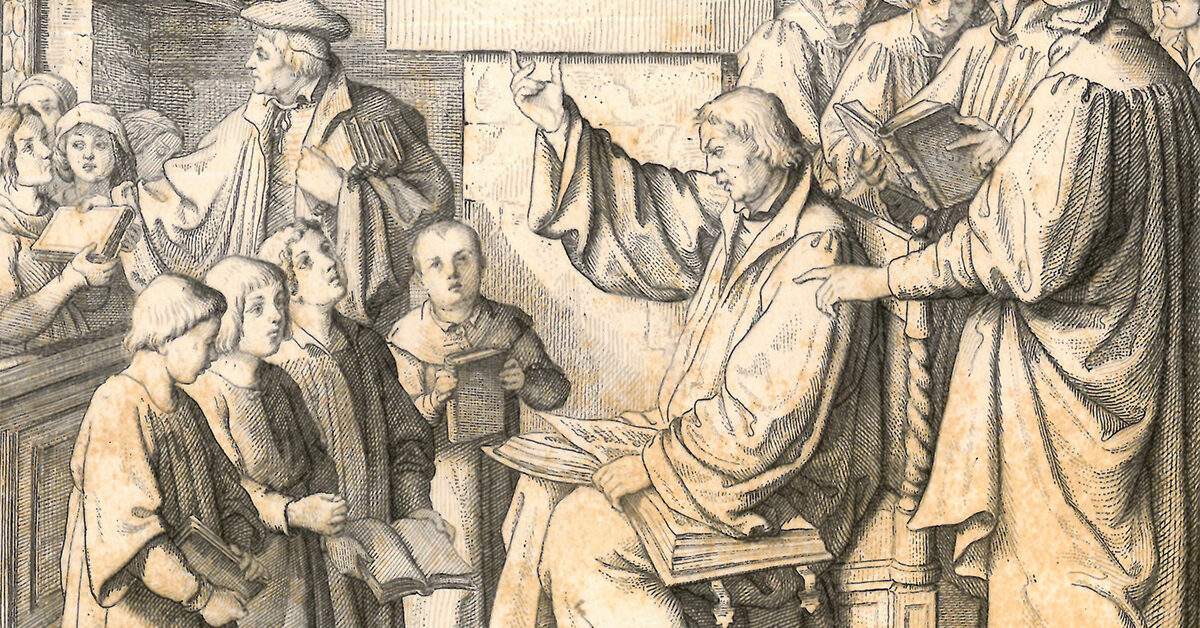
Banner Photo: König, Gustav Ferdinand Leopold. 1900. The life of Luther in forty-eight historical engravings. St. Louis: Concordia Publishing House.