Last month I (Rhoda) had the privilege and joy of serving as the keynote speaker at the LCMS Northwest District Youth and Family Ministry Conference, held at Camp Lutherhaven in Coeur d’Alene, Idaho. The theme of the conference, “Formed,” was a great opportunity to introduce some of the resources Kent and I have promoted through this website and our book, Journey to Jesus. For two of the sessions, the whole group (about 50 people) practiced the African Scripture Reflection Method and Luther’s Four-Strand Garland Scripture Reflection. I also facilitated a breakout session for those interested in the Visualization Method. Three people attended: DCE Scott Thurman (St. John Lutheran Church, Vancouver, WA), Deaconess Amanda Mumm (Immanuel Lutheran Church, Twin Falls, ID), and DCE Ethan Mirly (St. John Lutheran Church, Palmer, AK).
At our next plenary gathering, the three reported to the whole group what the process was like and presented their end “product,” a haiku poem based on the biblical text they had heard and discussed. Scott kindly wrote this narrative of their creative process.
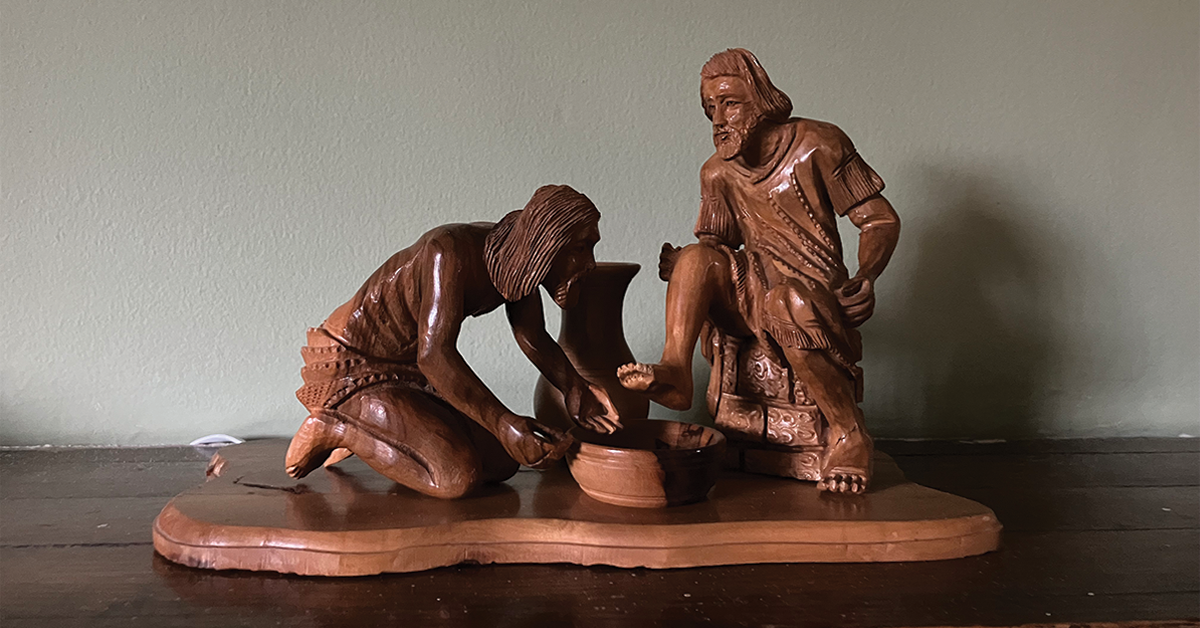
I was so amazed by the workshop breakout session entitled Visualizing Scripture. I worked with two other individuals, Amanda and Ethan, and we confronted the text involving Jesus washing the feet of the disciples. After reading it several times we shared important takeaways from this story. Each of us was experiencing the passage from different angles, and I was so impressed with the way our group shared things that stood out; images that caught our attention. After we shared and listened to each other, we began to imagine how we might present discoveries and excitement. At first, we were reaching far and wide, making connections with Old Testament and New Testament passages. But Dr. Schuler gently encouraged us to narrow our focus and to pay attention to strong motifs. Hands, feet, towel, water, baptism. After some struggle to distill our thoughts, we fashioned our ideas into a haiku. From 45 minutes of great discussion and shared insights, three short lines, a handful of words and syllables, emerged. In a haiku every word counts, and we took some time shaping and clarifying our poem. The learning from each of us felt meaningful, and we had grown closer through the process.
Here’s their haiku. Click on the image to watch it; Scott is in the middle.
By reflecting on the process, he named the strengths of this method. First, it deepens the meaning of the particular Scripture passage for the participants, forming their faith in Christ; and second, it forms the participates into community. Scott wrote:
Although the presentation of the poem took just seconds to share, we all felt that the time spent would last for a very long time. In this process the audience takes in a “product or presentation” that they did not have a hand in shaping. They may receive it and it does not have nearly the impact it had on each of us who created it. Their reaction, somewhat subdued, was not a measure of the experience we had as a team. In debriefing the presentation afterwards, it became clear to my colleagues and me that we had gained so much more from the process, and that the learning was much deeper and more significant for us. We realized that regardless of how seemingly simple our creation of a haiku was, what we created had a lasting impact. The joy and blessing in our discussion and the listening to one another had built friendships.