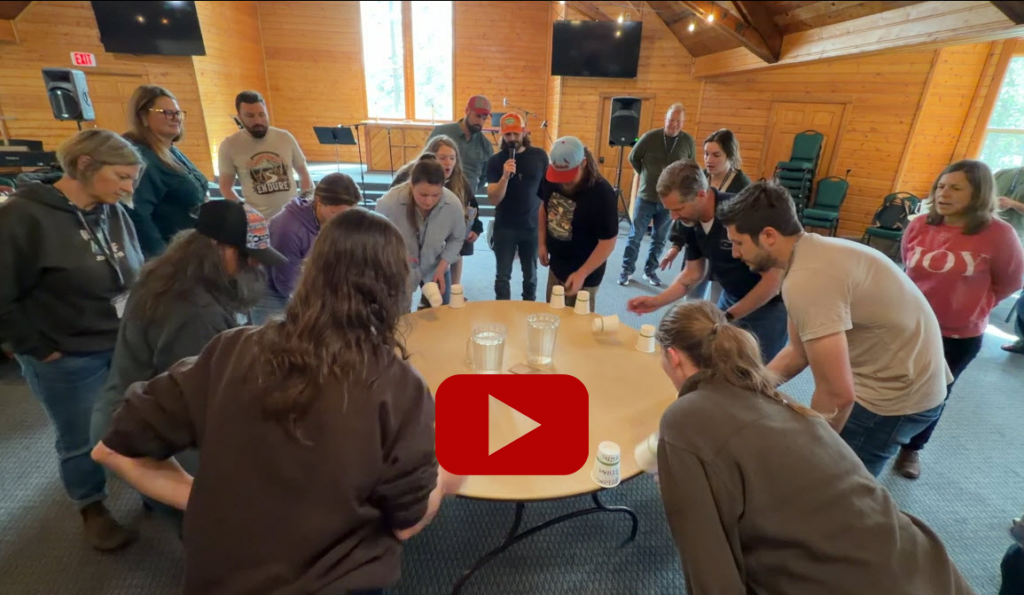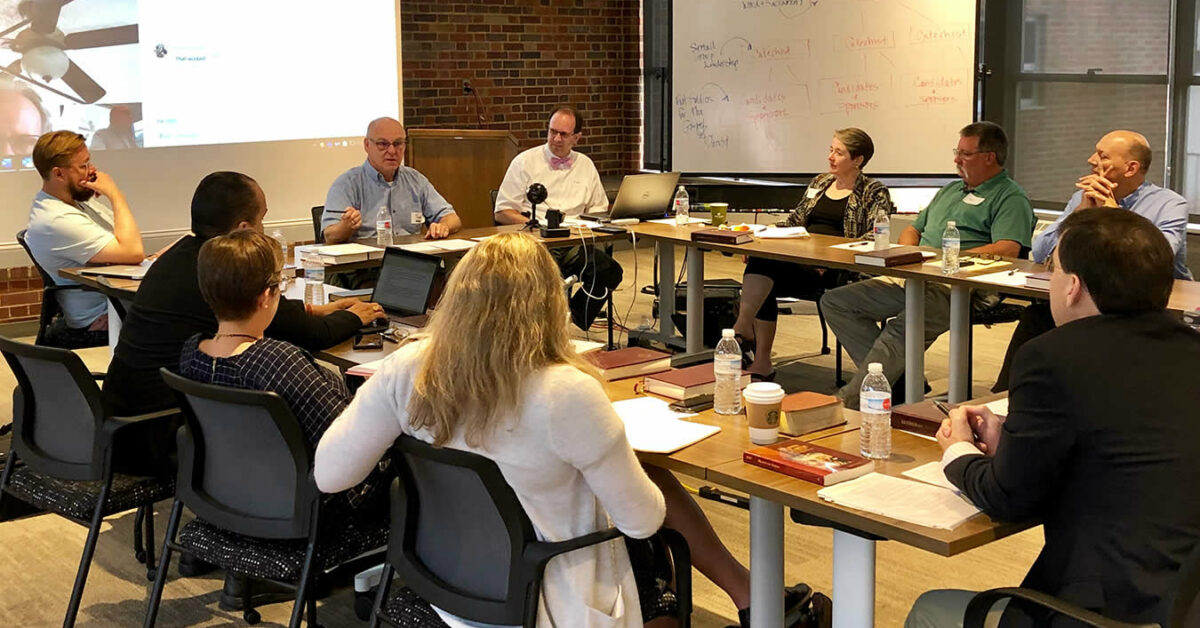
Last month I (Rhoda) had the privilege and joy of serving as the keynote speaker at the LCMS Northwest District Youth and Family Ministry Conference, held at Camp Lutheridge in Coeur d’Alene, Idaho. The theme of the conference, “Formed,” was a great opportunity to introduce some of the resources Kent and I have promoted through this website and our book, Journey to Jesus. For two of the sessions, the whole group (about 50 people) practiced the African Scripture Reflection Method and Luther’s Four-Strand Garland Scripture Reflection. I also facilitated a breakout session for those interested in the Visualization Method. Three people attended: DCE Scott Thurman (St. John Lutheran Church, Vancouver, WA), Deaconess Amanda Mumm (Immanuel Lutheran Church, Twin Falls, ID), and DCE Ethan Mirly (St. John Lutheran Church, Palmer, AK).
At our next plenary gathering, the three reported to the whole group what the process was like and presented their end “product,” a haiku poem based on the biblical text they had heard and discussed. Scott kindly wrote this narrative of their creative process.
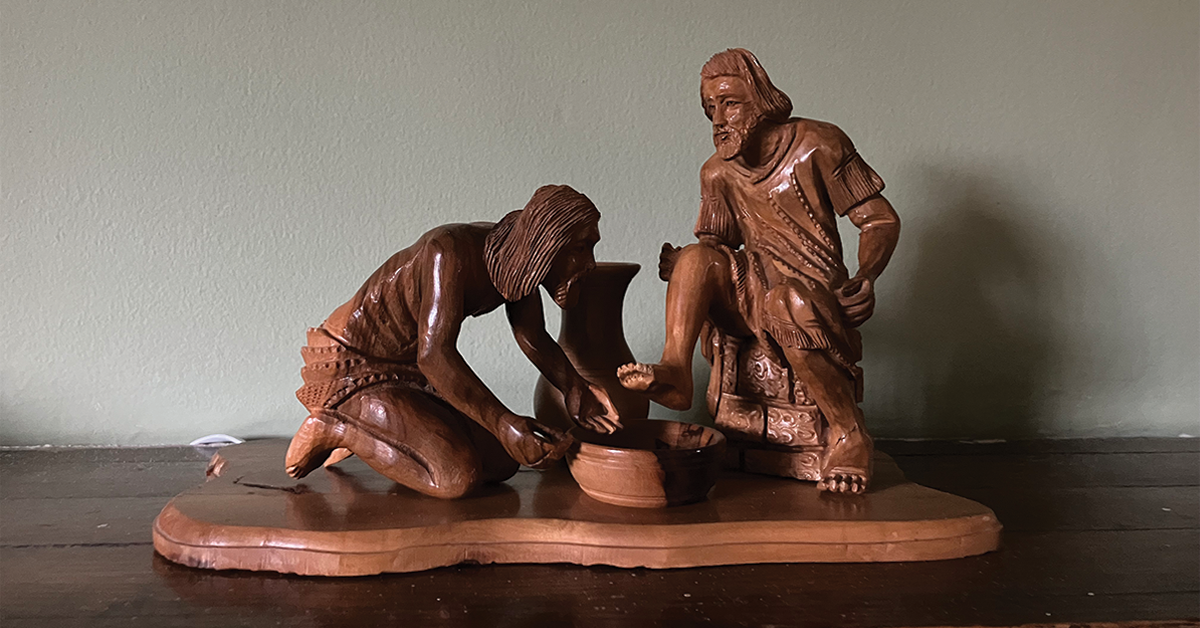
I was so amazed by the workshop breakout session entitled Visualizing Scripture. I worked with two other individuals, Amanda and Ethan, and we confronted the text involving Jesus washing the feet of the disciples. After reading it several times we shared important takeaways from this story. Each of us was experiencing the passage from different angles, and I was so impressed with the way our group shared things that stood out; images that caught our attention. After we shared and listened to each other, we began to imagine how we might present discoveries and excitement. At first, we were reaching far and wide, making connections with Old Testament and New Testament passages. But Dr. Schuler gently encouraged us to narrow our focus and to pay attention to strong motifs. Hands, feet, towel, water, baptism. After some struggle to distill our thoughts, we fashioned our ideas into a haiku. From 45 minutes of great discussion and shared insights, three short lines, a handful of words and syllables, emerged. In a haiku every word counts, and we took some time shaping and clarifying our poem. The learning from each of us felt meaningful, and we had grown closer through the process.
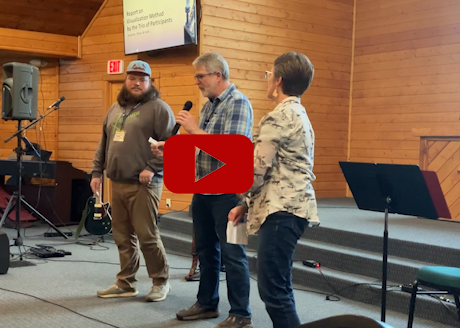
Here’s their haiku. Click on the image to watch it; Scott is in the middle.
By reflecting on the process, he named the strengths of this method. First, it deepens the meaning of the particular Scripture passage for the participants, forming their faith in Christ; and second, it forms the participates into community. Scott wrote:
Although the presentation of the poem took just seconds to share, we all felt that the time spent would last for a very long time. In this process the audience takes in a “product or presentation” that they did not have a hand in shaping. They may receive it and it does not have nearly the impact it had on each of us who created it. Their reaction, somewhat subdued, was not a measure of the experience we had as a team. In debriefing the presentation afterwards, it became clear to my colleagues and me that we had gained so much more from the process, and that the learning was much deeper and more significant for us. We realized that regardless of how seemingly simple our creation of a haiku was, what we created had a lasting impact. The joy and blessing in our discussion and the listening to one another had built friendships.
In this video interview, Dr. Lakies suggests that a “winsome witness” includes a willingness to enter into conversation with others in order to see people “in the complexity of their full humanity.”
The video is six minutes in length. To view, one must be logged into Google.
Pastor Lakies has been on the podcast circuit since the publication of his book. To learn more about the book, here’s a list of podcast options (click on the orange title for the link to each):
Looking at the commonalities we share with others (sports teams; civil goals, such as good education for our children) and connecting with folks in these ways.
Unpacking of his statement “Disagreement does not equal hate.”
A nuanced understanding of “authenticity”
Navigating some of the difficulties of maintaining relationships with others of differing views
Three goals of the resilient church (patience; forgiving; if you want the third, you’ll have to listen to the podcast.)
The hosts are Matt Popovits, pastor of St. Mark Lutheran Church in Houston, and Rachel Ryder. This podcast is a discussion of Matt’s book, Junk Drawer Jesus, and Chad’s book.
+++
Tangible: Theology Learned & Lived “Exploring the ways theology permeates all aspects of life” Concordiatheology.org; November 15, 2024; 35 minutes Host: Jessica Bordeleau; with Chad Lakies and Dale Meyer
As I’m a big fan of Rev. Dr. Dale Meyer, President Emeritus of Concordia Seminary, St. Louis, this one is my favorite. Topics include:
Back in the day: the church had a voice of relevance and trust
The book attempts to address the emotional state pastors serving today: frustration, anger, and sense of humiliation at the loss of relevance of the church in society
The church’s public witness is impacted by this emotional state of pastors and congregations; how can we offer a “winsome witness”?
Responses of congregations: Resignation, trying to be relevant, and resistance (a response to fear)
Historic liturgy as museum piece; worship is God breaking into our lives with Jesus and his word!
Navigating the “Two Kingdoms” theme from Luther’s theology
To soak ourselves in the Word of God is a way to renewed vitality in the church—and that’s a communal process
Things are not “going our way” today; there are lessons for us today from the early church
The Rev. Dr. Chad Lakies is the Vice President of Ministry Engagement for US Ministries at Lutheran Hour Ministries and author of How the Light Shines Through: Resilient Witness in Dark Times. The first of today’s video is from the beginning of our lengthy conversation on Zoom and touches on the connections between this book and Kent’s and my research on congregations with robust adult catechumenate.
This first video is less than four minutes; to watch it, one must be logged into Google Drive.
This next link is a bonus video in which Rev. Lakies offers the “testimonial” of his journey from “nonbeliever” to a person with faith in Christ. It is just under five minutes long. Chad speaks about the Holy Spirit working through the proclaimed Word of God, extravagant hospitality, and relationships with mature Christians. Next week’s post will be another video clip from this interview and a list of podcasts in which Chad speaks further about his book.
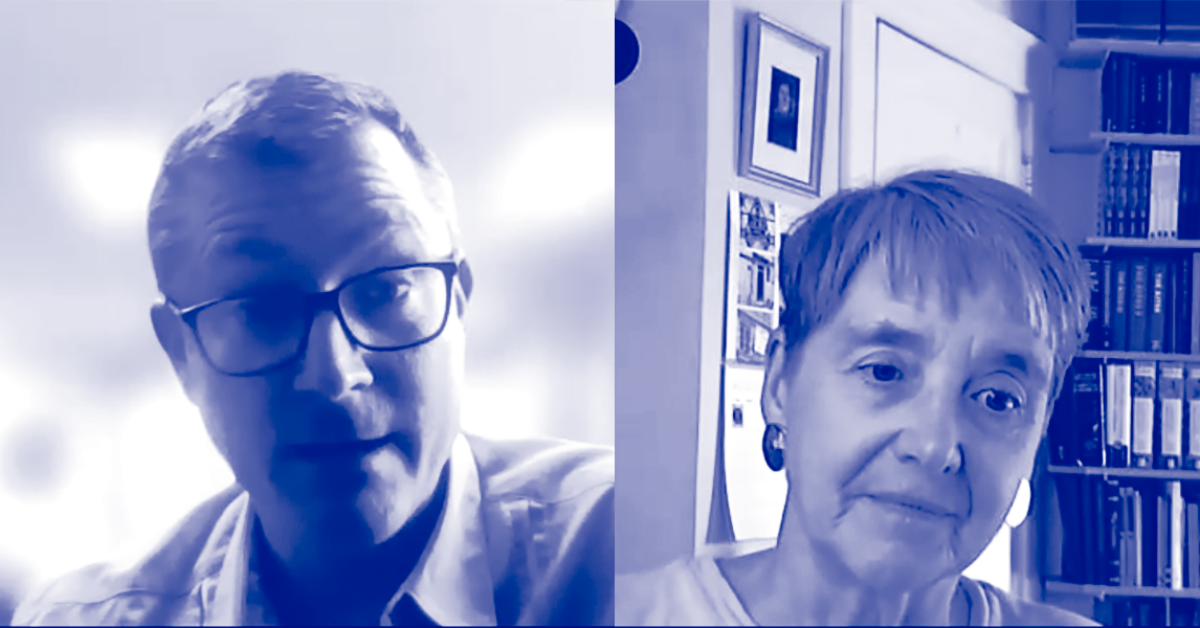
This week Rhoda interviews Kent and his other research partner and co-author, Dr. Beth Hoeltke, about their book Lay me in God’s Good Earth. The authors discuss how they got drawn into the topic of natural burial, the Christian lens of the book, and the expansive approach of the book, which encourages pastors and lay Christians to think proactively about end-of-life decisions as well as funeral practices.
To view this four-minute video, you must be logged into a Google account.
In addition to seven chapters, the book includes numerous resources for those interested in exploring the various facets of natural burial:
A burial planning guide
Cost comparisons for natural burial, conventional burial, and cremation
Resources about caring for the body at home and for burying naturally
A list of state funeral boards and licensing agencies for the District of Columbia and 48 states; Alaska and Hawaii are listed with “No state funeral board.”
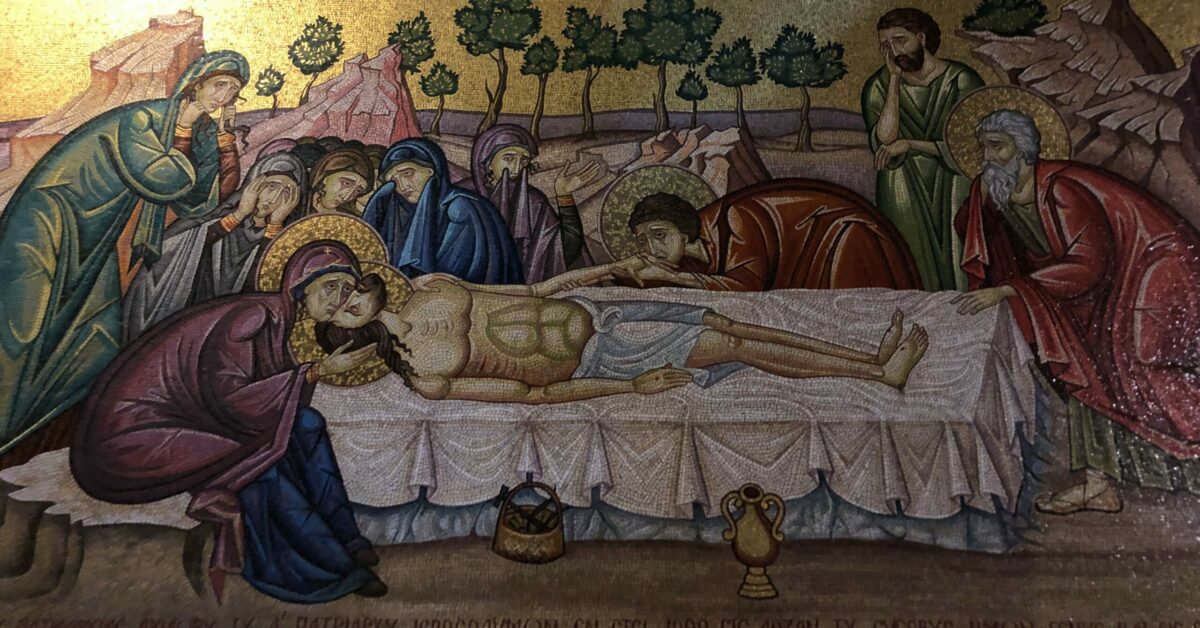
++++ Banner image: Modern mosaic depicting Jesus’ mother, Mary Magdalene, and other women preparing Jesus’ body for burial as Joseph of Arimathea and Nicodemus look on. Wall mounted inside the entrance to the Church of the Holy Sepulchre, Jerusalem.
As promised in last week’s blog, we’re hearing again from Pastor Eggold about the catechetical gatherings of those in adult formation at Grace Lutheran Church; in today’s video he describes the African or Lambeth method of Scripture study in detail.
I confess that after my first exposure to the African/Lambeth method, I was not 100% on board with it; my own preference for Bible study leans academic, toward biblical exegesis that informs my understanding for today by shedding light on a text’s meaning in its original historical context. There seemed to be little room for this more “scholarly” approach to Scripture study in the African/Lambeth practice. But if you listen carefully, you’ll hear the many ways which Pastor Eggold lays an exegetical foundation for the Gospel text before the small group study begins.
This video is six minutes. You must be logged into Google drive to access it.
In case you missed some, let me summarize the ways Dan Eggold lays a firm, Lutheran exegetical foundation:
Exposure to the Gospel text before the Washed and Welcomed gatherings
On Fridays the church sends out homework that catechumens are expected to do. This single sheet includes space for the catechumens to record questions they had as they read the text, to engage the text with their imagination, reflecting on what they “would … have seen, or heard, or felt?” And to write down “For this week: I want to remember … I want to put my faith into action by …”
On Sundays Participants attend worship, hearing the Gospel text read and the Word broken open in Pastor Eggold’s sermon.
After worship some also attend the Sunday Bible Class, which deliberately is a lectionary-based study during this part of the church year, taught by Pastor Eggold.
During the Washed and Welcomed gatherings, which follows worship and Bible study
As the fellowship meal is wrapping up, Pastor Eggold draws on the sermon he preached that morning to “help them make the transition to the small groups.” They hear again what a theologically trained Lutheran pastor has gleaned from the Gospel text.
Pastor Eggold writes the questions to which the people respond after the third reading of the text, a question that “is linked to the life of the church,” that calls for a real-life application of the text.
The catechists, as facilitators, keep the participants on track and draw them out in the discussion that follows the readings, silence, and responses. But the primary “teacher” of the faith is Pastor Eggold, whose careful work lays a foundation that is centered in the life, ministry, and saving activity of Jesus Christ.
I recently had a conversation with Pastor Daniel Eggold about his experience introducing an adult catechumenate at his current parish, Grace Lutheran Church in Lafayette, Indiana. Key to his vision was doing—not talking about—Christian practices. As he said, “Instead of talking about Bible study and the importance of it, we just do it; instead of talking about prayer and the importance prayer, we just do it.”
Here’s Pastor Eggold describing the catechist as facilitator of the “doing” in the weekly gatherings while he also unfolds the sequence of catechumenal gatherings from early January through Pentecost. This video is under three minutes. You must be logged into Google drive to access it.
In this second video (one and half minutes), Pastor Eggold describes how the catechist prepares the candidates and catechumens to pray for one another.
“It’s incredibly simple,” he says, but not quick. Pastor Eggold reported on the 18-month incubation process:
First, he said, he spent about six months reading widely about the topic, both current publications and classic texts.
Only after immersing himself in the theology and practice of an adult catechumenate, was he ready to introduce the topic to a small group of members from the congregation.
Their enthusiastic response was immediate, but it was another year of working together, training them for various roles, and integrating the catechumenal process with the parish calendar before the adult catechumenate started.
In next week’s blog, Pastor Eggold will explain how the catechists facilitate “just doing” Bible study in their small group.
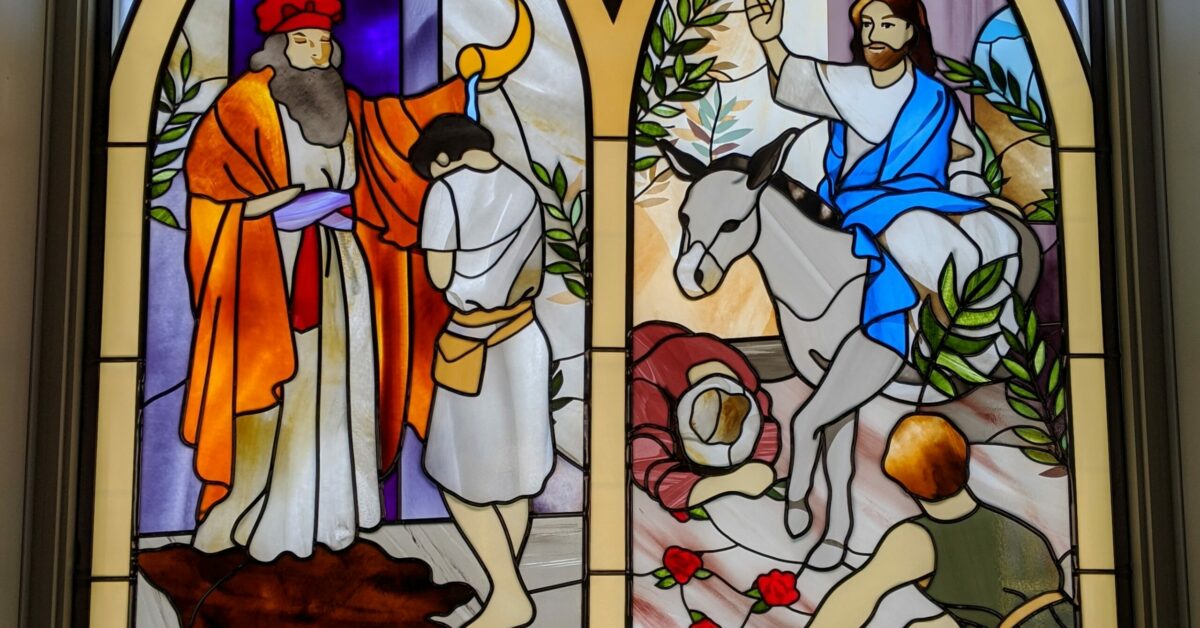
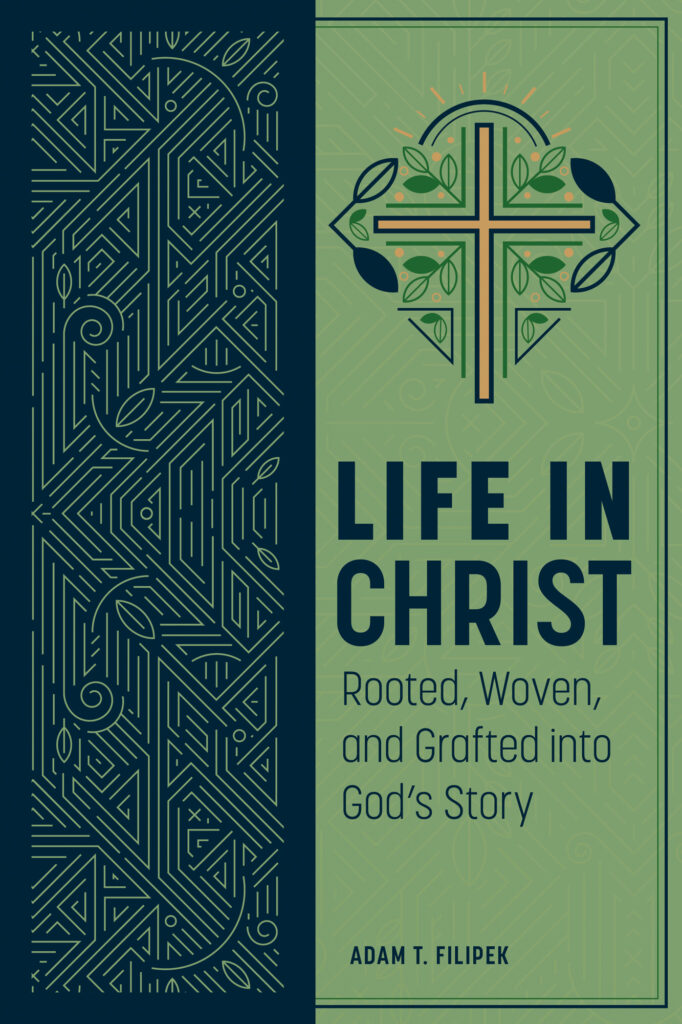
Life in Christ: Rooted, Woven, and Grafted into God’s Story is a new resource from Concordia Publishing House by the Rev. Dr. Adam T. Filipek, pastor of Holy Cross and Immanuel Lutheran Churches in Lidgerwood, North Dakota. In this video, Pastor Filipek speaks about his approach to articulating the Gospel of Jesus Christ—both in the book and in his preaching. He advocates for a narrative approach with an emphasis on typology as way to connect Old Testament stories with the fulfillment of God’s salvation through Christ in the New Testament. Also central to his approach is connecting that story of salvation in Scripture to “the story” of the hearer, so that people in the pew experience the “for me” of the biblical narrative.
In this video of four minutes, Pastor Filipek provides examples of this narrative approach. You must be logged into Google to view the video.
To read some reviews of the book, Life in Christ: Rooted, Woven, and Grafted into God’s Story, and for information on ordering it, click here.
Stained glass window: From Immanuel Lutheran Church, Lidgerwood, ND; for more information on the church’s windows, click here.
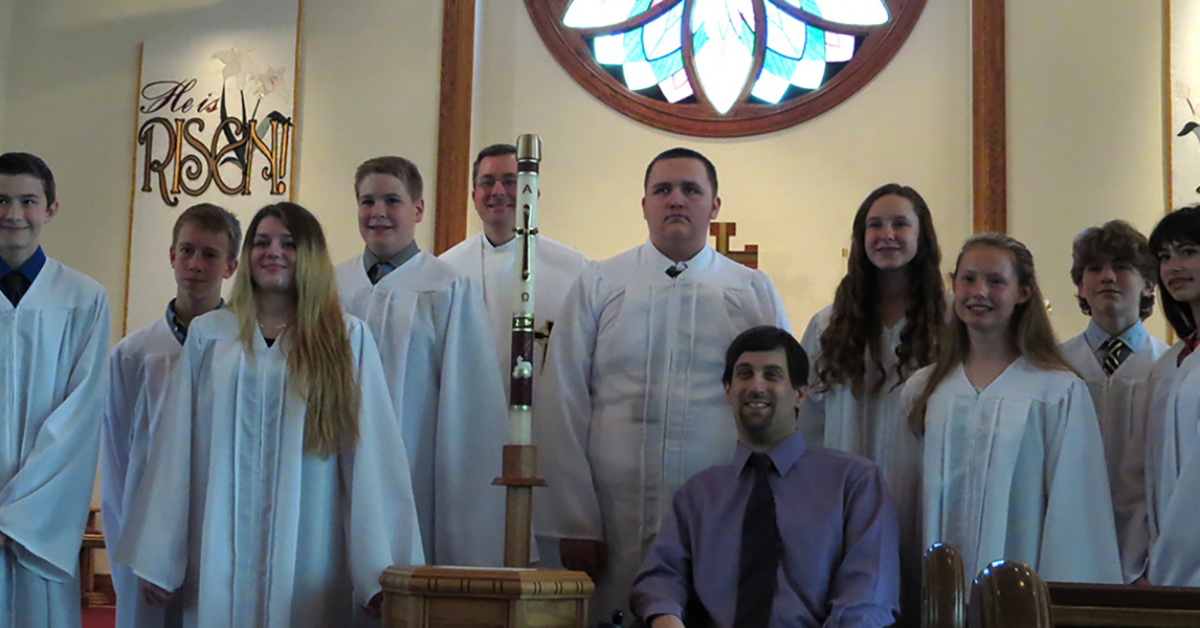
Pastor Dan Eggold (to the left of the Pascal Candle in the photo) from Grace Lutheran Church, Lafayette, Indiana discusses some “stealth practices” he has used to introduce ritual at Grace. This video is under five minutes long and worth your time. He begins introducing ritual with the youth confirmation and has now included ritual practices via “baby steps” into their adult faith formation process as well.
You must be logged into Google to view the video.
Remember: you must be logged into Google to view this video.
Sources named by Pastor Eggold in the video:
Welcome to Christ: Lutheran Rites for the Catechumenate (Augsburg Fortress, 1997)
This is the second (of three) video interviews with the Reverend Daniel Eggold, pastor of Grace Lutheran Church in Lafayette, Indiana. A few weeks ago, Pastor Eggold talked about the three ways in which the adult faith formation process at Grace has transformed his preaching: his sermons are more intimately connected to the biblical text; the sermons connect the text to the vocations of the people of Grace; and his preaching has a greater emphasis on the corporate nature of the church and life of the church, rather than about the life of the individual Christian.
In this week’s video, Pastor Eggold discusses how Washed and Welcomed, as the adult catechumenate is called at Grace Lutheran, has transformed the culture of the congregation. As he says, “we do not need more members; we need more disciples.” Instead of merely handing over a box of offering envelopes to “new members,” new disciples are asked in what way God has gifted them to serve others in the world and at Grace congregation.
This video is five minutes long; you’ll want to watch through end so that you hear one of the best examples of a transformed congregational culture. Reminder: You must be logged in Google to view it.
Kent and I have written and spoken and quoted others about the transformative power of an adult faith formation process for individuals and for a congregation committed to making such a process central to their mission. In today’s video the Rev. Daniel Eggold, pastor of Grace Lutheran Church in Lafayette, Indiana, speaks of three ways in which the adult faith formation process in his congregation has transformed a key aspect of his pastoral ministry: preaching.
This video is about five and half minutes long, and the great content far outweighs the poor visual quality of the recording. You must be logged into Google to view it.
This image file is in public domain, not copyrighted, no rights reserved, free for any use, … without the prior written permission and without fee or obligation.