Review of “Ever to Emmaus” by Arthur A. Just Jr. (Part 2)
Rhoda ended last week’s blog with Arthur Just’s words about good pastoral ministry in the context of and oriented toward the Eucharist, which is always for him and for all of us a Return to Emmaus, an act of remembrance. Section two of the memoir, entitled “Jesus and Mary,” remembers Just’s teaching of the “Gospels as Kerygmatic Memoirs,” especially the Gospel of Luke and enunciates an incipient Lukan (and Lutheran) theology of Mary, who in the church’s remembrance on the basis of Luke’s Gospel is arguably the second most important person in Luke’s narrative. The book is worth reading for innumerable reasons, not the least of which is Just’s provision of a much-needed Lutheran theology of Mary.
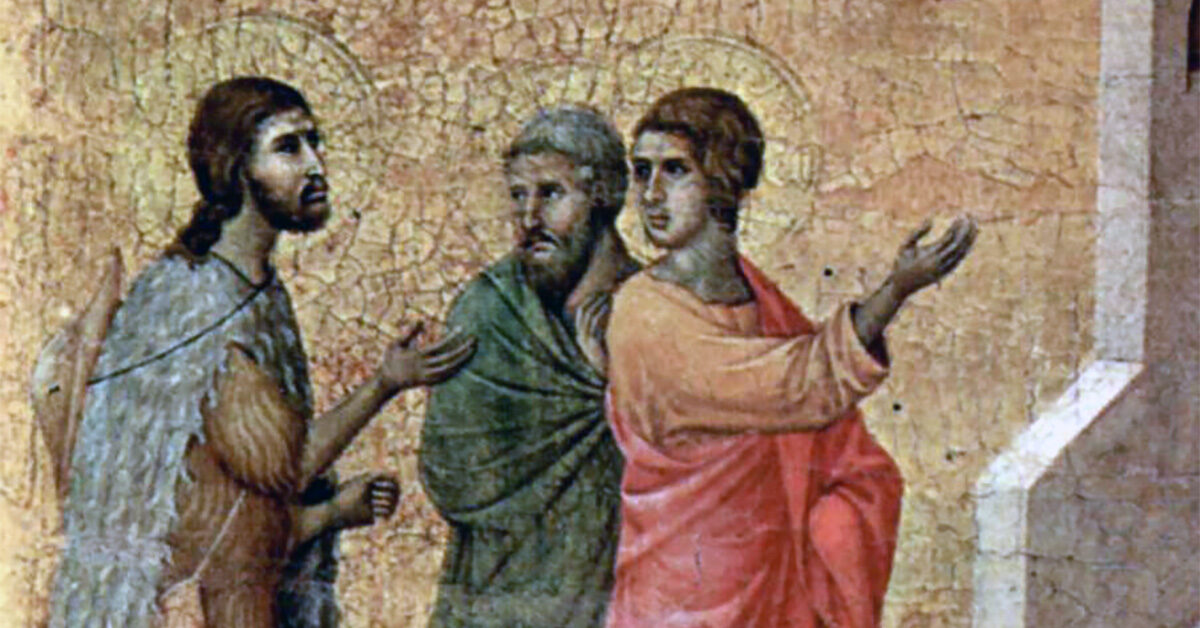
In chapter 6, “Returning to Emmaus,” Just returns to the “blick,” the hermeneutical insight of seeing clearly the high Christology and high sacramentology of the Scriptures, that weaves as the thread through all of his teaching of the Gospel of Luke. That Scriptural hermeneutic is not only read and interpreted, but experience through the catechumenal life as our camino, our journey. As Just writes,
Emmaus captures the entire paschal mystery, and the two Emmaus disciples embody the confusion, denial, and conversion of everyone who struggles with the mystery of Christ’s incarnation and passion, and how in the Eucharist we proclaim his death until he comes (113).
The act of remembrance is thus always a matter of kerygmatic/sacramental interpretation for the sake of catechesis. In that context Just remembers his teaching of the Lukan narrative through the question of whether the Emmaus account is eucharistic. He retells his negotiating—not explicitly identifying it as the Eucharist— through that with both one of his doctoral readers and with other CTS faculty during the Babylonian Captivity at CTS. In this memoir, in the freedom of the Gospel, he can remember in ways that are congruous with his teaching all along:
The reason it is important to understand Emmaus as the first post-resurrection Eucharist is that the eyes of the Emmaus disciples are opened in the breaking of the bread. . . . the climax of Luke’s Gospel, for it is the first time a human being recognizes Jesus as the crucified and risen Lord. . . . Jesus is in the center. And this is the moment of conversion for the Emmaus disciples. . . . Emmaus teaches us that Word (teaching on the road) and Sacrament (the breaking of the bread) must go together. In that order. The teaching prepares for the opening of the eyes. Word prepares for Sacrament (119-120).
It is the catechumenate! And the catechumenate drives toward the certainty of faith: “Catechesis in the catechumenate precedes baptism, and the climax of a full conversion is the Lord’s Supper, which comes immediately following washing at the font, for after you are reborn, the church feeds you holy food” (125). The catechumenate discloses to us living by faith in all of life through the paschal mystery.
Chapter 7, “A Lukan (and Lutheran) Theology of Mary,” is a much needed tour-de-force of Luke’s remembrance of Mary. Just notes the need for a robust theology of Mary in relating to fellow Christians who hold her in the highest respect and honor, even if Mary is placed in untenable theological positions. Just places her in the right position of honor in accord with Luke’s gospel by recounting four things: “Mary as the New Israel, the Temple, and the Ark of the Covenant; Mary’s Hermeneutic of Humility—Breaking What is Whole and Making Whole What is Broken; The Memoirs of Mary as She Ponders the Meaning of Jesus’ Birth and Suffering; and Mary as the New Eve and Mother of the Family of God” (139). While there is much that could be highlighted, for the sake of this blog Just’s observation about the Annunciation and the catechumenate is revealing:
The annunciation is a first glimpse of the pattern of incorporation into the church that will be followed throughout Luke-Acts: catechesis, baptism, and Lord’s Supper—the pattern continued by the post-apostolic church. Mary prefigures this as she receives catechesis from the angel, the Holy Spirit comes upon her, and she receives the flesh of Christ (146).
Mary’s importance for the church’s life, often understated in Lutheran circles, should not be. As Just emphatically concludes,
She knew her home was no longer in Nazareth or in Ephesus but where her Son was, and that, of course, is at font, pulpit, and table. She became an evangelist by telling her story to others, and finally telling it to Luke, who canonized it in his infancy narrative. But most of all, she was a mother, first to Jesus and then to his church. . . . So as Lutherans, we honor Mary, for her Son did. He had her blood, and it was her blood in him that washed away our sins. For this we owe her our utmost devotion (161-2).