Review of “Ever to Emmaus” by Arthur A. Just Jr.
With this post, Kent and I begin a series reviewing a new book, Ever to Emmaus: A Theological Memoir, by our friend Arthur Just, Professor of New Testament at Concordia Theological Seminary, Ft. Wayne, Indiana. Since Art graciously wrote one of the forewords to our book, Journey to Jesus, we’re delighted to be able to thank him by featuring this newly published work.
The opening words of the Prologue – “The room was large and the sherry was dry” – immediately drew me into Art’s story. The Prologue, the story of his doctoral dissertation (Luke’s Gospel through the lens of the Emmaus account), sets the stage for the theme of the book. His dissertation advisor declared, “Emmaus is a story that will serve you until you close your eyes in death. You will always be ‘Ever to Emmaus’” (xxiv).
Part I is titled “A Story of Pilgrimage,” and each of the five chapters has a pilgrimage theme. In the opening chapter Art joins his story to that of all Christians, declaring that “we are always on pilgrimage to Emmaus for hearts to burn and eyes to be opened in the breaking of the bread” (12). Although autobiographical and conversational in tone, he closes the first chapter as a good academic, stating that he “will argue that a postmodern church will look like a premodern church, and that means that ‘tradition’ must be either reinvented or restored as a way forward for the generation of my children and grandchildren” (14).
Chapter 2, cleverly titled “A Just Conversion,” chronicles his early years through the lens of his spiritual “pilgrimage” that led to embracing his calling to pastoral ministry. Art claims that a key to this “conversion” for him was an inner dialogue akin to Mary’s “pondering” after the Annunciation and what Paul likely experienced for the three days in Damacus before Annanias restored his sight. His musing – “One wonders how, in the process of evangelization, we could be more intentional in directing the inner conversation of those who are bit by the Gospel and are seeking His face always” (37) – struck a chord with me, because, like Art, I am deeply immersed in such questions relating to the adult catechumenate.
In Chapter 3, “The Camino,” Art recounts walking the full 500-mile medieval pilgrimage route through France and Spain at age 55 with his 19-year-old son (who often trekked ahead of his father to secure prime space at the pilgrimage hostel and to scope out dinner options). He concludes the chapter not at the end point, Santiago de Compostela, but at a stop only a third of the way on the route, with a description of the Mass (and details of the priest’s homily) in the small but beautiful church in San Juan de Ortega attended by locals and pilgrims alike. He writes:
As a priest in the parish for twenty-five years, he had seen countless pilgrims walking the Camino for all kinds of reasons. But he believed, deep down, that we were all walking this road for one reason and one reason alone—we were searching for our home, and perhaps, perhaps, on these paths we would find it in Christ, and that when we arrived in Santiago, we might know where our true home is (61).
With “Novel Theology,” Art uses his knowledge of literature (his undergraduate major was a History-English) to expound on “the Lutheran distinction between law and gospel that is … fundamental to the biblical narrative” and is present, according to Just, in two novels, The Great Gatsby and A Prayer for Owen Meany. I commend this chapter to English majors and lovers of literature.
The final chapter in part one, “Old School: Hemingway and the Prodigal,” reveals Art as simultaneously a literary critic and caring pastor whose empathetic listening to parishioners is informed by the suffering of the literary characters he has analyzed. I close with these words (next to which I made a large star in the margin):
The circumstances of life can overwhelm the saints in our congregations, but with good pastoral care, good preaching, our people will come back to Christ by a pastor who connects their sufferings to the sufferings of Christ, especially through the Eucharist, so that they may say with Paul, “For to me to live is Christ, and to die is gain” (Phil 1:21). (103, emphasis added.)
++++++
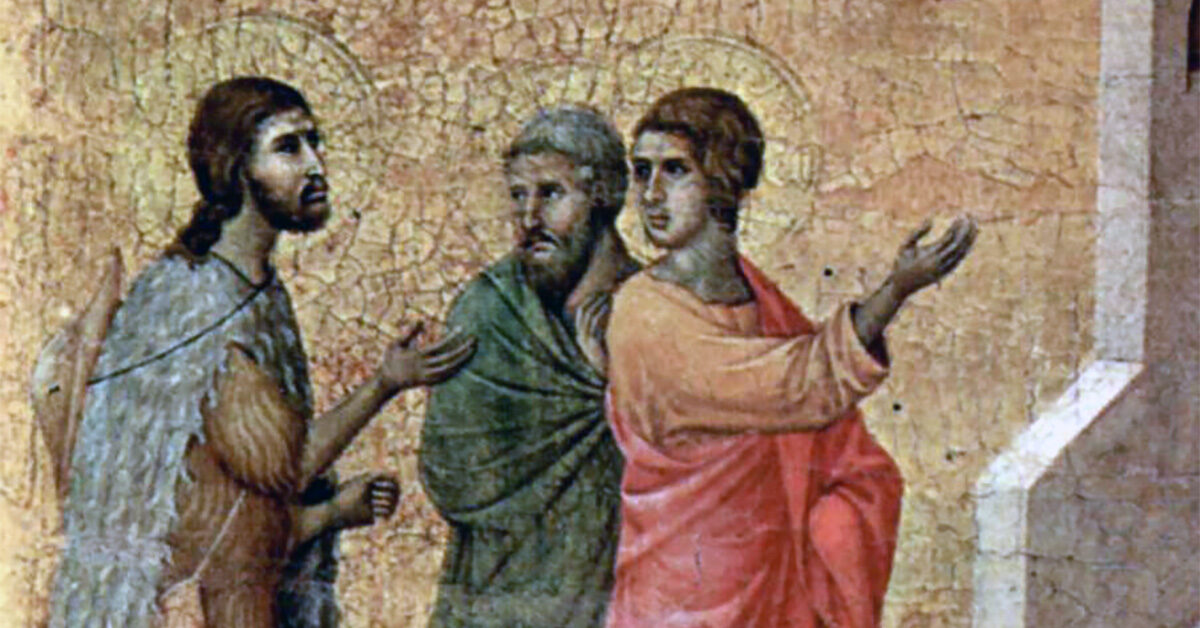
Banner image: Jesus and the two disciples On the Road to Emmaus, by Duccio di Buoninsegna (1255-1319); Altarpiece of Siena Cathedral, reverse side, main register with scenes from the Passion of Christ; scenes: Christ appears to two pilgrim apostles at Emmaus.
Source/photographer: The Yorck Project (2002) 10.000 Meisterwerke der Malerei (DVD-ROM), distributed by DIRECTMEDIA Publishing GmbH. ISBN: 3936122202.https://commons.wikimedia.org/w/index.php?curid=3799693