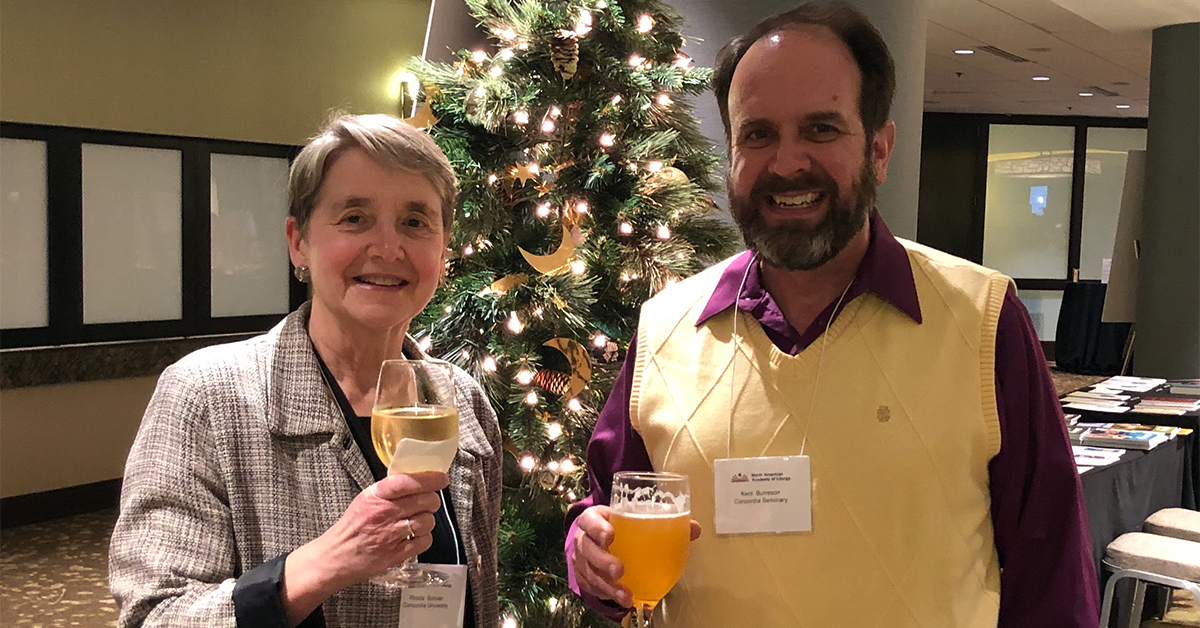
Kent and Rhoda are taking a week off from blog posting to attend the Annual Meeting of the North American Academy of Liturgy. It is a great opportunity for us to engage with other scholars in the field, to read and discuss papers on liturgical topics written by colleagues and offer feedback on works-in-progress, and also to read published works by members within and outside of the Academy. As the photo shows, there’s also time for socializing. Both of us have been attending NAAL since we were in graduate school. Here’s a brief quotation from the Vice President’s address we heard on Tuesday evening:
Both historical and ethnographic liturgy have built in guardrails to prevent me from assuming the cultural or temporal other is totally unlike me; both also hinder me from making the other too much like myself. Rather, the third space of liturgical studies schools me in cosmological encounter. Here I meet others who, like me, find transcendence in liturgy, but in practices that I find unfamiliar or distasteful. I also meet those who are deeply unlike me but find transcendence in practices that move me too.
The presenter, Dr. Kimberly Belcher from the University of Notre Dame, set the stage for thoughtful and respectful conversations in this academic setting. We are grateful to be part of NAAL, which has both nurtured and challenged our thinking and scholarship.
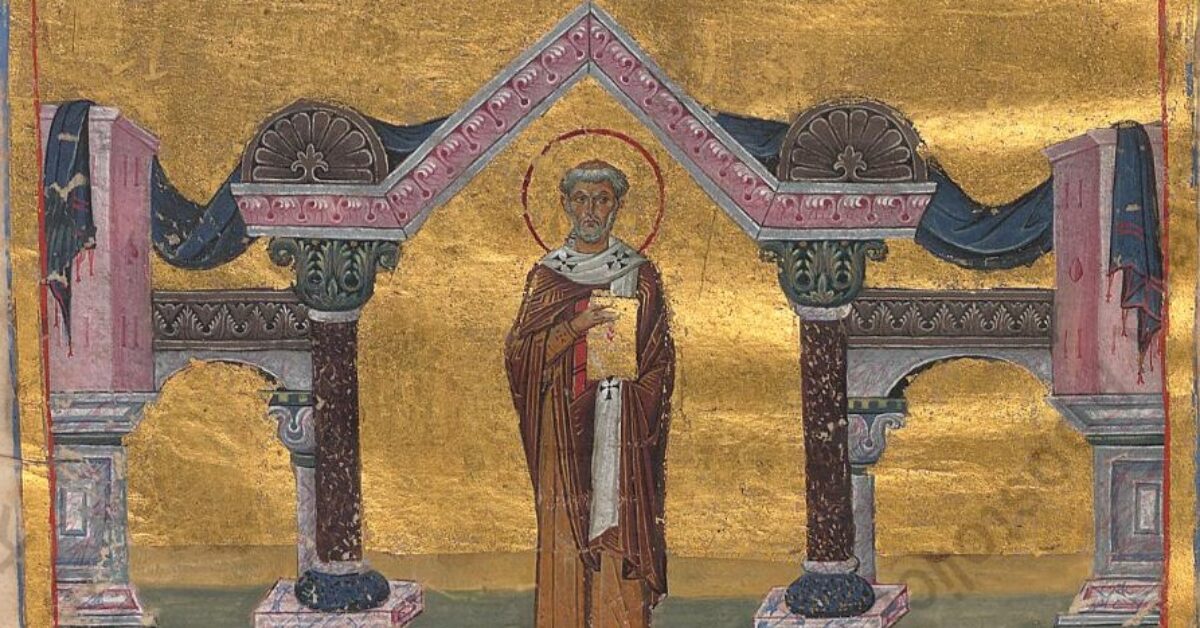
This excerpt from Leo the Great’s Christmas sermon (preached in 450) draws together biblical themes of baptism with the mystery of the Incarnation:
Christ’s birth, says Leo, is “the origin of” all Christians, the body of Christ
Just as we have been joined with Christ’s death and resurrection in baptism, so we are “born along with him in his Nativity”
Jesus is born to Mary, “the child of a human being” in order that we might “become children of God”
May these ancient words by Leo the Great draw our readers to contemplate the Incarnation and its meaning in daily life in new ways.
When the faithful meditate about divine things, dearly beloved, the Birth of our Lord and Savior from his Mother comes to mind every day and all the time….
But no day suggests to us more than today that this Nativity should be worshipped in heaven and on earth…. We recall not only to mind, but even—in a way—to sight, the conversation of Gabriel with the astonished Mary, the Conception by the Holy Spirit (as marvelous in being promised as it was in being actually granted), the Maker of the world brought forth from a virginal womb, and the one who established all natures made the Son of her whom he had created.
On this day, the Word of God appeared clothed in flesh, and, what could not even have been seen by human eyes before, “could” now “be touched with the hands.” …
… Today’s feast, nevertheless, renews for us the sacred beginnings of Jesus’ Birth from the Virgin Mary. As we worship the Birth of our Savior, we find ourselves celebrating our own origin as well. For the Conception of Christ is the origin of the Christian people, and the birthday of the Head is the birthday of the body.
All of the elect have their own special place, and the Church’s children are set off from one another by the passage of time. Yet all of us, the whole sum of believers who have sprung from the baptismal font, just as we have been crucified with Christ in his Passion, been raised with him in his Resurrection, and been set at the right hand of the Father in his Ascension, so too have we been born along with him in his Nativity.
Whenever believers in any part of the world undergo regeneration in Christ, they become transformed into “new human beings,” through a rebirth … It was precisely so that we might be able to become children of God that he was made the child of a human being. Had he not come down to us in this humility, none could come to him by any merits of their own.
Leo the Great: Sermons (translated by Jane Patricia Freeland, C.S.B.J., and Agnes Josephine Conway, S.S.J.)
Title: Лев I Великий, папа Римский. Константинополь. 985 г. Миниатюра Минология Василия II. Ватиканская библиотека. Рим
Google translation of the Russian: Leo I the Great, Pope of Rome. Constantinople. [date:] 985. Miniature … of Basil II [Byzantine Emperor, r. 976-1025]. Vatican Library. Rome
For one who grew up on a farm in the Midwest, Thanksgiving Day meant more than church and cooking, turkey and the trimmings, football and family. The hymn that conveys the origin of the day is in the “Harvest and Thanksgiving” section (that title alone says much) of The Lutheran Hymnal, #574.
Come, ye thankful people, come; Raise the song of Harvest-home. All be safely gathered in Ere the winter storms begin. God, our Maker, doth provide For our wants to be supplied. Come to God’s own temple, come; Raise the song of Harvest-home.
My parents breathed a sigh of relief when the harvest was “safely gathered in” before Thanksgiving Day and we could give thanks to God for that blessing. Some years, however, when the weather was less than ideal, we still attended church and had a festive meal with extended family, but the harvest continued. I remember one very difficult year, full of rain and multiple breakdowns of machinery, when we gave thanks that my father finished the harvest just before Christmas.
This year seems a bit like that difficult harvest time from my childhood. Everything seems to be going awry—wars in Ukraine, in Israel and Gaza; thousands of economic migrants risking their lives to seek a better future for their children; “hidden hunger” affecting 30% of the world’s population;[1] political discord in our country that seems unbridgeable; a mental health epidemic among adolescents and young adults; the list is endless. But into this world of darkness, Paul’s words to the church at Phillipi remind that “the Lord is near,” and so we are called to rejoice … not worry … and pray with thanks.
Rejoice in the Lord always; again I will say, Rejoice. Let your gentleness be known to everyone. The Lord is near. Do not worry about anything, but in everything by prayer and supplication with thanksgiving let your requests be made known to God. And the peace of God, which surpasses all understanding, will guard your hearts and your minds in Christ Jesus. Philippians 4:4-7
Paul, writing from prison and speaking from his experience of personal suffering and an uncertain future, can say with confidence, “in everything by prayer and supplication with thanksgiving let your requests be made known to God.”
Blessed thanksgiving to our readers.
+++++++
In next week’s blog, Kent will resume his series on the characteristics of missional churches.
St. Mary’s Lutheran Church*, one of the congregations where we did our research, imparts three lessons for beginning an effective adult faith formation process.
Lesson 1: Create buy-in among current active members
After attending a conference led by Paul E. Hoffman, author of Faith Forming Faith, Pastor M followed Paul’s advice and offered a summer Scripture study group to introduce the small group process to current members. This group met between four and six times throughout the summer, engaging in the kind of Scripture meditation Kent described in his post from September 7, using questions about a biblical text that “allow the Word to be proclaimed so that the individual and the community embrace this story as their own account (confession) of who they are.” Because St. Mary’s is a small congregation, the participation by members over the summer, which people reported was very positive experience, was enough to convince the congregation as whole to venture on this new path.
Lesson 2: Begin with a group of inactive members
St. Mary’s boldly started with two small groups that fall. The first was an existing group of retired women who welcomed a young woman (living with one of the retirees because of a temporary housing crisis) into their study group. The young woman and retirees bonded closely over their weekly meditations on and sharing about the story of Jesus. The group convinced Pastor M of the power of the process to form community, especially across generations.
The second small group included inactive or” estranged” members who were connected enough to the congregation to participate in this new venture. Pastor M described the impact on one woman in this group, who was “being folded back in the community” of faith and was now (three years later), active in the congregation and in the adult faith formation process.
Lesson 3: Embrace the practice of serving a meal before the Scripture study
Pastor M, a self-described “convert” to this practice, commented more than once about the power of sharing food together as a way to form community. The goal of an adult catechumenate is more than strengthening the individual’s relationship to Jesus Christ. Baptism, through which the Trinity claims individual persons to be sons and daughters of God, also brings God’s newborn children into the community of faith. It’s within the church that each person engages in the life-long process of dying to sin and rising to Christ, of turning away from self-centeredness to become Christ-like witnesses of God’s love in the world. A shared meal introduces individuals into the joy of communal life and the spiritual support, the bearing of one another’s burdens, that St. Paul exhorts us to in Galatians (5:2).
These three lessons share a common theme: that the adult catechumenate is “not an instructional process, but a process of faith formation,” according to Pastor M. Of course, imparting information is part of the package, but the primary task is forming disciples. This is a lifelong task that at St. Mary’s began by strengthening the faith of committed members; that in the next step drew an estranged member back into the active life of the community and who was transformed into a disciple committed to sharing the Good News with others; and that over the course of three years of an adult faith formation process, always included a shared meal to create and foster community among the neophytes and their sponsors.
___________________
*A pseudonym
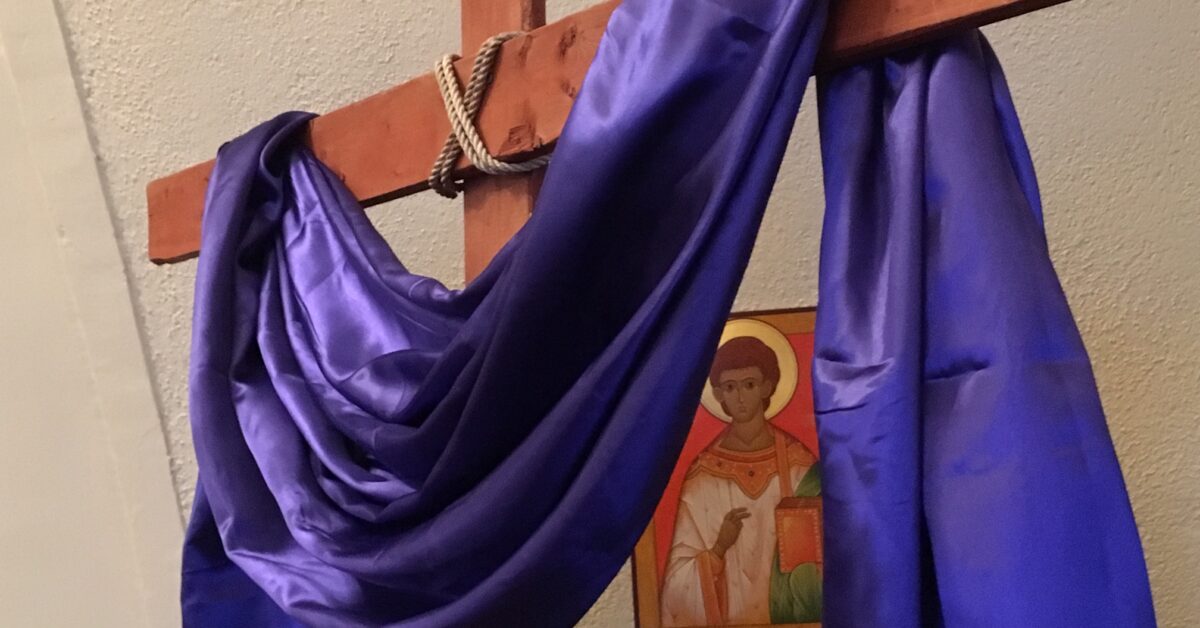
Photo (by Rhoda Schuler): St. Mary’s Lutheran Church during Lent
As promised in last week’s blog, we’re hearing again from Pastor Eggold about the catechetical gatherings of those in adult formation at Grace Lutheran Church; in today’s video he describes the African or Lambeth method of Scripture study in detail.
I confess that after my first exposure to the African/Lambeth method, I was not 100% on board with it; my own preference for Bible study leans academic, toward biblical exegesis that informs my understanding for today by shedding light on a text’s meaning in its original historical context. There seemed to be little room for this more “scholarly” approach to Scripture study in the African/Lambeth practice. But if you listen carefully, you’ll hear the many ways which Pastor Eggold lays an exegetical foundation for the Gospel text before the small group study begins.
This video is six minutes. You must be logged into Google drive to access it.
In case you missed some, let me summarize the ways Dan Eggold lays a firm, Lutheran exegetical foundation:
Exposure to the Gospel text before the Washed and Welcomed gatherings
On Fridays the church sends out homework that catechumens are expected to do. This single sheet includes space for the catechumens to record questions they had as they read the text, to engage the text with their imagination, reflecting on what they “would … have seen, or heard, or felt?” And to write down “For this week: I want to remember … I want to put my faith into action by …”
On Sundays Participants attend worship, hearing the Gospel text read and the Word broken open in Pastor Eggold’s sermon.
After worship some also attend the Sunday Bible Class, which deliberately is a lectionary-based study during this part of the church year, taught by Pastor Eggold.
During the Washed and Welcomed gatherings, which follows worship and Bible study
As the fellowship meal is wrapping up, Pastor Eggold draws on the sermon he preached that morning to “help them make the transition to the small groups.” They hear again what a theologically trained Lutheran pastor has gleaned from the Gospel text.
Pastor Eggold writes the questions to which the people respond after the third reading of the text, a question that “is linked to the life of the church,” that calls for a real-life application of the text.
The catechists, as facilitators, keep the participants on track and draw them out in the discussion that follows the readings, silence, and responses. But the primary “teacher” of the faith is Pastor Eggold, whose careful work lays a foundation that is centered in the life, ministry, and saving activity of Jesus Christ.
I recently had a conversation with Pastor Daniel Eggold about his experience introducing an adult catechumenate at his current parish, Grace Lutheran Church in Lafayette, Indiana. Key to his vision was doing—not talking about—Christian practices. As he said, “Instead of talking about Bible study and the importance of it, we just do it; instead of talking about prayer and the importance prayer, we just do it.”
Here’s Pastor Eggold describing the catechist as facilitator of the “doing” in the weekly gatherings while he also unfolds the sequence of catechumenal gatherings from early January through Pentecost. This video is under three minutes. You must be logged into Google drive to access it.
In this second video (one and half minutes), Pastor Eggold describes how the catechist prepares the candidates and catechumens to pray for one another.
“It’s incredibly simple,” he says, but not quick. Pastor Eggold reported on the 18-month incubation process:
First, he said, he spent about six months reading widely about the topic, both current publications and classic texts.
Only after immersing himself in the theology and practice of an adult catechumenate, was he ready to introduce the topic to a small group of members from the congregation.
Their enthusiastic response was immediate, but it was another year of working together, training them for various roles, and integrating the catechumenal process with the parish calendar before the adult catechumenate started.
In next week’s blog, Pastor Eggold will explain how the catechists facilitate “just doing” Bible study in their small group.
In our recent workshop on the adult catechumenate, we stressed the importance of creating small groups to build community and foster an environment for seekers to ask questions and to respond genuinely to biblical texts. The research of Anna Clare Creedon (Do Small Groups Work? A Study of Biblical Engagement and Transformation, London, SCM Press, 2021) offers support for our claims about the value of small groups. Creedon set out “to explore whether the context of a small group provides the necessary conditions for transformative biblical engagement to take place” (1). Her data draws from study of three small groups associated with parishes in the Church of England.
The data point to three major themes:
The role of an “expert,” that is, a person with scholarly theological training (95)
“challenge [that] emerged as a result of engagement with the text and as a result of engagement with others in the group” (116)
The “use of materials” by the group to help them understand biblical material (137)
Creedon’s findings on an “expert” are twofold. First, she notes that those experts who “embrace their role as ‘skilled master builder’ [1 Cor 3:10], and use their expertise to serve the small group” are “more likely to facilitate transformative biblical engagement” than experts who offer “right answers” (115). The presence of the latter type of experts can create an environment where others in the group defer to the “expert,” dampening discussion (96-98), keeping it at an “intellectual level” (115), and thus inhibiting the desired transformation.
Creedon identified the second theme as “challenge” because the word was used by the subject participating in the research and because one can be “challenged” both by others and by a biblical text (116); a majority of in all the groups she studied named it “very important or fairly important that their views were challenged” (117). She also concluded that for “transformative biblical engagement” to happen, participants need to be challenged by the biblical text, and that “small groups can provide a facilitative context for this challenge to take place” (136, emphasis in original).
In her discussion of the third theme, “use of materials,” the author considered both what and how materials were used, primarily the latter (137). She offers these conclusions:
“… the data does suggest that incorporating a range of materials, either in one session or across a number of sessions … may be more likely to generate a great diversity of insights into the biblical text, and thus potentially lead to transformative biblical engagement” (158).
“The data points towards the conclusion that the deeper discussions emerged from material that had been altered or specially chosen by the group leader” (156).
Our own research has affinities with Creedon’s work. At one of our research congregations, participants were invited to respond to narratives from the Gospels. The lay catechist and pastor agreed that the latter’s presence in the group led to the kind of “deferring to the expert” that Creedon also uncovered in her research. At another of our research congregations, the catechetical gatherings were successfully led by the pastor, primarily because he developed his own material and because of his ability to “read the room” and adapt to the particular needs of the group.
In the end, of course, the work of the Spirit to transform lives by creating faith in Jesus Christ cannot be pinned down by modern “research methods.” Our research, as Thomas Aquinas might say, is a “handmaiden” to Scripture, one that can shed helpful light on human efforts to live out the Great Commission. Even as we hope that our research may led to more congregations adopt a robust adult faith formation process, we also keep in mind these words of Jesus to Nicodemus:
The wind blows where it chooses, and you hear the sound of it, but you do not know where it comes from or where it goes. So it is with everyone who is born of the Spirit” (John 3:8)
+++++++++++++++++++++++++++++++++++
Image: Pentecost icon, egg tempera on wood panel. Russian, 18th century. 53.5 x 45 cm.
As we prepared for our July workshop on Adult Faith Formation, we included three timeslots to present different approaches to Scripture meditation and study designed to engage “inquirers”—people who may have little knowledge of the Christian faith and content of the Bible but who, through the work of the Holy Spirit, have expressed an interest in exploring Christianity and learning about Jesus. Kent sent me the instructions for one such model called the “Visualization Scripture Study,” and when I read through it, my first reaction was, “I would get up and leave the room if I were asked to do this in a small group.” While firmly doubting the value of this method, I dutifully proofread the document and made sure that Kent would lead this section of the workshop.
All the Scripture meditations we practiced with the group start in a similar manner: the Gospel reading for the previous Sunday is read aloud, silence is kept for a time, and members of the small group share with one another a word, phrase, or image that caught their attention. The text is read a second time with a different prompt. Then, the instructions for the visualization method continue, “Each team collaborates creatively to visualize the story in some way.” Examples given include acting out the story, drawing the story, writing a song or “a poem or haiku (or even a limerick).”
The appointed Gospel reading was John 3, Nicodemus coming to Jesus by night and questioning how one could be “born again.” After the reading, silence, and sharing, the teams were giving the above instructions. At first, there were tentative, quiet conversations, but soon each group worked earnestly, and some with joy and laughter. This doubting Thomas’s resistance to the process began to break down, and I was completely transformed to the possibilities of this method when the teams presented their work—full of fun and deep theological insights into the text.
There were two “dramas” of the story, both starring “Nick and Josh,” with one drama set on a fishing boat in a Minnesota lake. I wish I had recorded it to share here! I did capture photos of the poems, which include a haiku and limerick, shared here. Note the way each one captures the essence of the story and the saving work of Jesus.
As we debriefed the process, Anna, trained as an educator, pointed out that this activity taps into multiple learning styles, including the creative process, which is at the top of Bloom’s (revised) taxonomy of educational goals. Click here for more information.
Tom, one of the pastors, described his reaction to the activity. First, he said, he experienced “resistance,” but then moved to “engagement and then acceptance.” His experience, he said, “could be the journey of a catechumen.” Or, I would add, of this Doubting Thomas.
“When I heard the sound of the water poured from the pitcher as the words were being spoken, the memories from the abundant use of water from the videos we watched flooded my mind.”
“I experienced the prayer time at the end of the service more intensely than I usually do.”
I warned the participants (all ten who attended our workshop on adult faith formation in early July) as we reviewed learning goal #3—”to experience rituals that might be used in your context to foster a missional ethos and welcoming spirit in your congregation”—I warned them that “Kent and I are liturgy geeks” who know firsthand about the transformative power of ritual done well, full of grace and beauty. We wanted to give them a taste of such ritual.
Built into the workshop schedule were ritual experiences that are the normal part of the typical adult catechumenal formational process, rituals that mark the transition from one stage of the catechumenal process to the next. After enacting rituals with the workshop participants in the roles of catechumens and sponsors, the participants had time to reflect individually and then discuss in the group how they experienced these tactile, aural, and olfactory rites. We ended the second day by viewing a “classic” video, “This Is the Night,” of adult baptisms administered in a large, walk-in font at a Roman Catholic parish during the Easter Vigil, followed by a video from Redeemer Evangelical Lutheran Church in The Bronx during their Vigil as a young adult was baptized with an abundance of water. The Service of Baptismal Thanksgiving—with baptismal invocation, song, Scripture, a thanksgiving for baptism spoken as water was poured into our make-shift font, renunciation and confession from the rite of baptism, and an extended time of intercession—began our third and final day. The above quotations are responses from participants as we discussed how they experienced the baptismal renewal ritual. I, too, had been deeply moved by the time of intercessions for the church, world, and all in need, offered by many participants and was reminded of Martin Luther, writing in his treatise The Freedom of a Christian,
Not only are we the freest of kings but we are also priests forever. This is far better than being kings, for as priests we are worthy to appear before God, to pray for others … Thus Christ has made it possible for us, provided we trust him, to be not only … fellow rulers of his kingdom but also his fellow priests. Therefore, we can come before God boldly in the spirit of faith and cry, “Abba, Father.” Praying for one another, we do all things that pertain to the duties and visible works of priests.
The Freedom of a Christian, Study Edition translated and with introduction by Mark D. Tranvik, p. 67.
Adult faith formation is designed to lead people to the freedom we have in Christ, who takes on all our sin in exchange for his righteousness, and who frees us for lives of thanksgiving to God and service to our neighbor.
We are pleased to announce that 10 people are currently attending our Visioning Lab, “From Font to Table: Welcoming the Stranger into Christ and Congregational Life” at Concordia University – St. Paul (CSP). We are thankful for the partnership between Concordia Seminary, St. Louis and CSP that made this event possible, especially Erika Bennett, Director of Continuing Education at the seminary, and Jane Wilke, Director of Church Relations at CSP.
We’re sharing a few photos of the group, which includes pastors, commissioned ministers, and laity among the participants; they have come from Minnesota, Iowa, South Dakota, and New York.
If you cannot see the pictures, open the email message in a web browser.